
Research methodology and editorial standards
How Klinko uses data-model denoising, DETECT, DECODE, ranking, evidence trails, and Signal Watch to make audience decisions credible and continuously current.
Klinko's method is neither traditional user research nor social media monitoring. It first uses audience-specific data modeling to remove duplicates, spam, bots, promotion, and off-topic material from public signals. DETECT surfaces candidate segments; DECODE explains purchase motivation; ranking makes a decision while preserving an evidence trail. Signal Watch remembers why the decision was made and reports when it starts to expire.
The direct answer: what the Klinko method does
Traditional research usually begins after a team already knows whom to study. Social listening usually ends at what people are saying. Klinko is built for a founder without analysts and answers five connected questions:
- Which segments show real demand and action signals?
- Who is most worth serving first?
- Why do they act, and what language do they use?
- What positioning, content, channel, and validation direction follows?
- Which changes mean the original decision should be revised?
The output is not a dashboard or static report. It is an evidence-linked, prioritized audience decision that can produce work and remain current.

Layer one: audience-specific data-model denoising
A source link does not make a source signal reliable. One news item can be syndicated hundreds of times; a community thread can be amplified by a few prolific accounts; a keyword can spike because of ambiguity or promotion. A general model can turn that noise into a fluent but fragile conclusion.
| Raw noise | Klinko treatment | Error prevented |
|---|---|---|
| Duplicates and cross-platform copies | Collapse into one canonical observation while preserving origins | Counting copies as demand |
| Bots, spam, promotion, and affiliates | Remove or down-weight abnormal frequency and commercial motivation | Treating marketing volume as customer need |
| Ambiguity, drift, and short spikes | Classify context and compare with a time baseline | Treating unrelated attention as opportunity |
| One platform or behavior | Corroborate search, communities, creators, reviews, and market signals | Treating platform bias as the whole audience |
| Supporting and opposing evidence | Keep counterexamples, scope, and confidence | Cherry-picking support for an existing idea |
Layer two: DETECT, DECODE, ranking, and evidence
| Action | Question | Klinko output |
|---|---|---|
| DETECT | Which segments show clear need, action, or payment signals? | Three to eight identifiable, reachable candidate segments |
| DECODE | Why do they buy, when do they act, what blocks them, and how do they speak? | Motives, pains, barriers, triggers, and audience language |
| Ranking | If resources permit one bet, who should be served first? | Priority based on demand, buying power, fit, reachability, and whitespace |
| Evidence trail | Why should a founder trust and explain the decision? | Claims connected to signals, dates, scope, inference, and confidence |
A ranking is not universal truth. It is an explainable decision under the company's current constraints. Klinko shows why a segment leads and what new evidence could reverse the order.

Layer three: turn the decision into a service direction
Klinko does not stop at a persona or mention count. DECODE organizes the leading segment's pains, triggers, barriers, and language into positioning, content, channel, and validation actions. Agent Canvas is an optional execution interface, not the center of the method. The center remains a decision grounded in denoised, traceable signals.
Layer four: Signal Watch keeps the decision alive
Audience decisions expire. Signal Watch remembers why a segment was selected and observes six shifts: demand intensity, new pains, competitor entry, language drift, channel migration, and segment splitting.
| Cadence | Purpose | Action |
|---|---|---|
| Weekly digest | Maintain awareness of meaningful movement | Keep watching or update the execution direction |
| Material alert | Identify a shift large enough to affect the decision | Adjust positioning, content, channel, or product hypothesis |
| Monthly rerank | Compare the chosen segment with alternatives again | Keep the priority or return to DETECT |
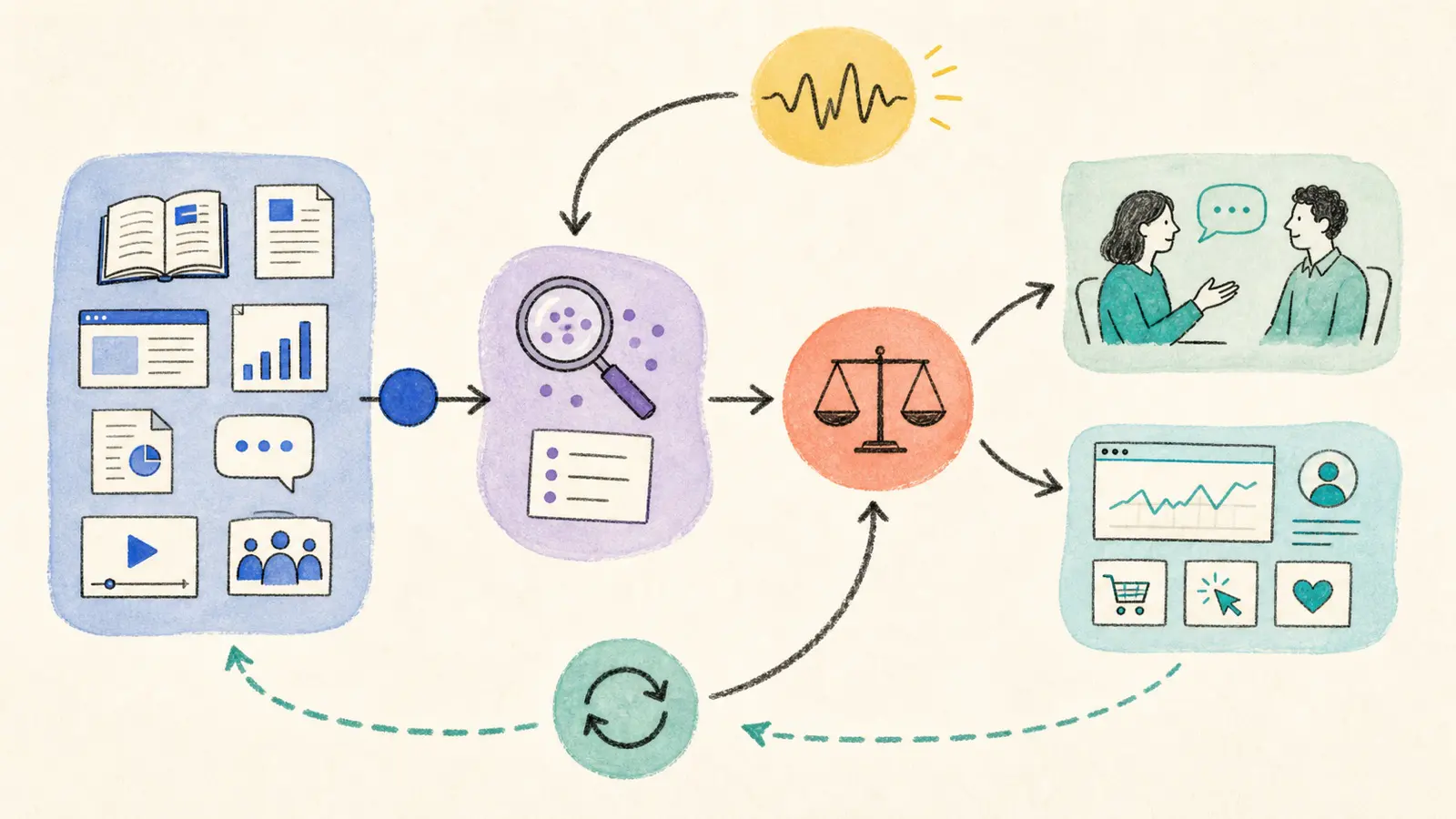
Worked example: one founder makes a pre-launch audience decision
Consider an independent founder launching a video-collaboration product with enough resources for one segment. Klinko detects independent editors, small creative agencies, and in-house social teams from public signals. After removing promotion, copies, and repeated complaints, DECODE compares approval pain, budget ownership, switching friction, and reachable channels.
If small agencies lead under the current weights, Klinko exposes the evidence, confidence, reasons, and reversal conditions, then recommends positioning and validation around “approvals no longer disappear into chat threads.” Signal Watch tracks competitors, pain language, and channel movement, prompting a reassessment before conversion falls for a quarter.
This is an illustrative product workflow, not a fabricated customer result.
Real data shows why audience decisions need monitoring
Pew Research Center's 2025 U.S. social media study shows adult TikTok use rising from 21% in 2021 to 37% in 2025, Instagram from 40% to 50%, and Reddit from 18% to 26%. Those figures do not represent every niche, but they demonstrate that a channel and language decision that was reasonable four years ago may now be wrong. Klinko therefore stores dates, baselines, and reranking logic instead of presenting a one-time analysis as a permanent persona.
Evidence boundaries and editorial standards
Klinko's public-signal method is not a statistically representative population survey and cannot prove product-market fit by itself. Private communities, offline behavior, and silent observers may be missing. A high-cost decision can still use a price test, paid pilot, or direct conversation for final validation—but traditional research then deepens one narrowed segment; it does not replace Klinko's discovery, denoising, ranking, and monitoring loop.
Numerical claims on this site link to original publishers; vendor-reported figures are labeled; observations and inferences remain separate. Klinko does not turn third-party feature lists into product recommendations. Pages are updated when evidence, product capability, or a conclusion materially changes.
FAQ about the Klinko research method
How is Klinko different from traditional user research?
Traditional research generally starts after a team knows whom to study. Klinko first DETECTs candidate segments from denoised public signals, DECODEs motivation, and ranks who to serve first—built for founders who do not have a research team.
How is Klinko different from social media monitoring?
Social monitoring usually reports mentions, sentiment, and topics. Klinko removes audience-signal noise, forms and ranks segments, recommends how to serve one, then Signal Watch remembers the evidence and monitors change.
Why is a Klinko audience decision more trustworthy?
Klinko does not send raw webpages directly to a model. It deduplicates signals, filters promotion and weak context, detects abnormal activity, and corroborates sources before connecting each conclusion to dates, scope, and confidence.
What does Signal Watch monitor?
Signal Watch remembers the audience decision and tracks demand, new pains, competitor entry, language drift, channel migration, and segment splitting. Material change prompts a message, creative, channel, or ranking update.