
What content will your audience actually care about?
Popular angles saturate fast. Klinko surfaces your audience's real pain points, trigger words, and preferences — so you create content that resonates and converts, not content that just fills a calendar.
Rider stories · style breakdowns · community conversations
How do you find content topics that rank and influence decisions?
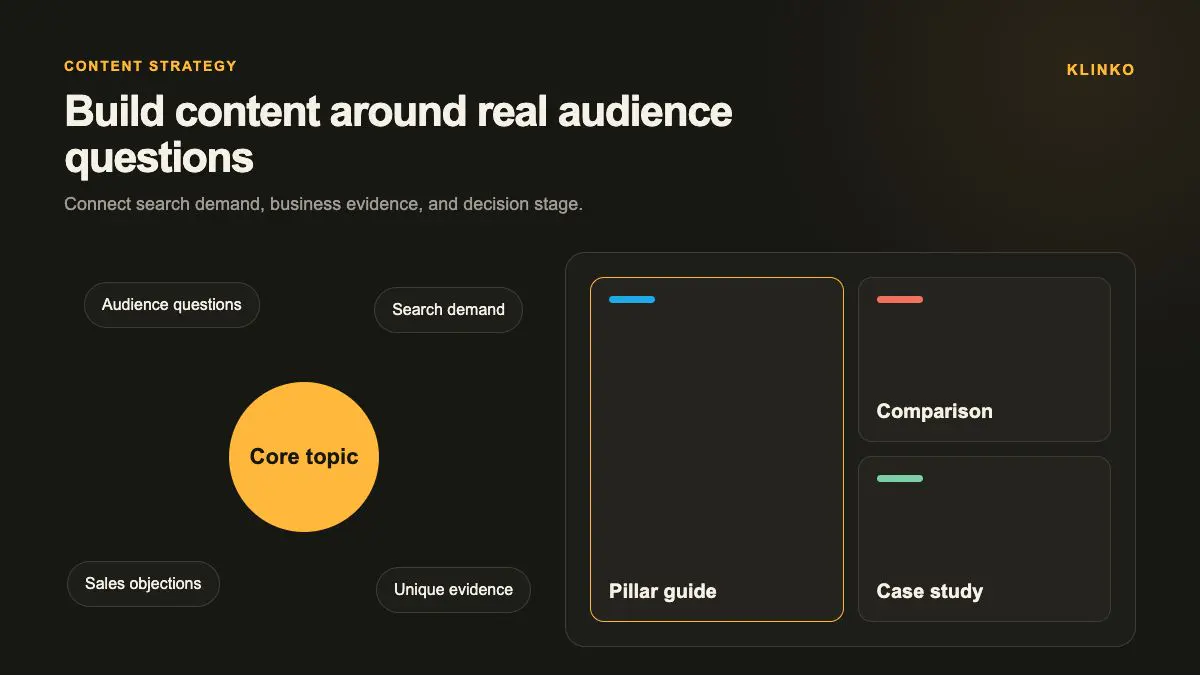
Do not prioritize content by search volume alone. Combine audience problems, buying stage, brand evidence, and the ability to publish sustained expertise. The best topics are repeatedly asked, poorly answered elsewhere, and supported by data or experience your brand can uniquely provide.
Key evidence:2024 Edelman–LinkedIn B2B Thought Leadership Impact Report
Public case: Spotify turned audience data into a content product
Spotify Wrapped combines proprietary listening data, identity expression, and sharing into a repeatable content system. Spotify says its 2015 Year in Music drew more than 5 million unique users; by 2023, additions such as Sound Town and Me in 2023 helped Wrapped engage a record 227 million monthly active users. The lesson is that defensible content often sits where proprietary evidence meets audience self-expression.
Spotify Newsroom: A decade of WrappedNot another monitoring dashboard: move from denoised signals to a decision that stays current
Klinko centers on audience-specific data-model denoising and the continuous relationship created by Signal Watch plus memory.
- 01Denoise
Deduplicate and cluster search questions, communities, reviews, and creator signals
- 02Decide
Rank content by audience need, buying stage, brand evidence, and citation potential
- 03Act
Output a topic cluster, information gain, evidence requirements, and publishing order
- 04Signal Watch
Watch topic movement, new questions, and channel change to keep the cluster current
Turn research into a four-step decision
- 1. Build a question bank
Combine search questions, community threads, sales objections, and customer-success notes.
- 2. Map buying stages
Cover awareness, comparison, validation, purchase, and use—not just beginner traffic.
- 3. Assign evidence
Pair each topic with data, cases, screenshots, experts, or experiments.
- 4. Build a cluster
Use one pillar page plus method, comparison, case, and FAQ pages with internal links.
Decide whether the evidence supports action
Disclosure: these are public cases and third-party research, not claimed Klinko customer results.
Make content the audience was already looking for
Content direction is knowing what to make before you make it: the themes, angles, and words your audience already responds to. Without it, you're publishing on instinct and hoping something sticks.
Klinko reads public signals to surface the pain points, trigger words, and formats your specific audience cares about — so each piece starts from evidence, resonates more deeply, and converts more reliably.
Create from evidence, not instinct
Klinko tells you what your audience actually cares about — before you spend a week making it.
Find the real pain points
See what your audience actually struggles with and talks about — in their own words.
Catch the trigger words
Learn the language and angles that make them stop, click, and share.
Get content directions
Turn it into concrete themes and formats worth making first.
Questions founders ask
What is content direction?
How is this better than a keyword tool?
Does it write the content?
Who is this for?
Make content your audience was waiting for
Start free and get content directions grounded in what your audience actually cares about — in minutes.