
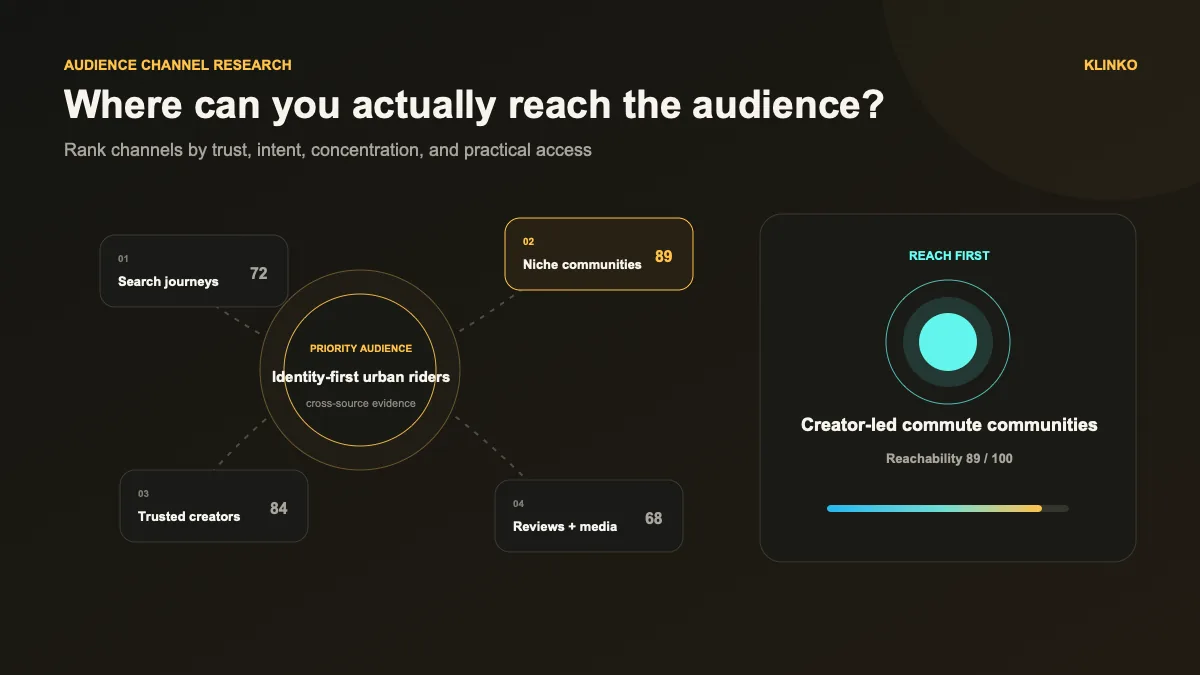
Where can you actually reach your target audience?
Klinko finds the search journeys, communities, creators, websites, and media where your chosen audience concentrates attention and intent — then ranks where to start.
Reachability 89 / 100 · Cross-source match
How do you find where a target audience spends attention?
Do not choose a channel from total platform size. Map where a specific audience asks questions, compares alternatives, trusts recommendations, and can be reached without breaking the budget. Klinko combines channel concentration, commercial intent, trust, access cost, and format fit to recommend a channel sequence rather than a generic list of popular platforms.
Source: Pew Research Center, Americans’ Social Media Use 2025
Public data lesson: the largest platform is not automatically the right channel
Pew Research Center’s 2025 U.S. survey reports broad YouTube use alongside meaningful growth and demographic differences across Instagram, TikTok, WhatsApp, Reddit, and other platforms. Those national figures establish a boundary, not a channel recommendation for every niche. Klinko narrows the question to the chosen audience: where their problem appears, where they compare options, whose recommendations carry trust, and which path the team can access consistently.
Pew Research Center report and methodology ↗Move from public signals to a testable next move
- 1. Start from the chosen audience
Use a concrete segment and buying situation; “people on social media” is not a usable channel boundary.
- 2. Map attention and intent separately
A place can attract attention without containing research, comparison, or buying behavior. Preserve the difference.
- 3. Identify trust carriers
Find communities, creators, publications, search results, and peer voices that repeatedly shape the audience’s decisions.
- 4. Score practical access
Compare concentration, intent, trust, access cost, format fit, response time, and the team’s ability to participate credibly.
- 5. Build a channel sequence
Choose one primary discovery channel, one trust-building channel, and one conversion path instead of spreading effort everywhere.
- 6. Watch migration
Monitor whether audience language, creator influence, community activity, or search behavior moves to a different channel.
Decide whether the evidence supports action
Disclosure: public cases and third-party research explain the method; they are not claimed Klinko customer results.
Questions founders ask
Does Klinko only analyze social media?
What is the best channel for reaching a target audience?
How is this different from social listening?
Can channel recommendations change?
Find the first channel worth earning
Start with a target audience. Klinko maps where trust and intent appear, then ranks the channel sequence worth testing.