
How do you know when your audience has moved on?
You picked a segment. You built for it, wrote for it, spent on it. Six months later, is it still the right one? Klinko keeps watching — and tells you the week it changes, not the quarter.
3 material shifts · Updated today
Which market signals should a company monitor continuously?
Monitor the decision you already made: demand direction, pain-point language, competitor entry, channel migration, and audience fragmentation. A useful alert explains whether a change is large and credible enough to require action; mention volume alone does not.
Key evidence:Spotify Newsroom: A decade of Wrapped
Public case: Spotify keeps evolving Wrapped with audience signals
Spotify did not freeze Wrapped as an annual template. It responded to identity, sharing, and local-culture signals, moving from a 2015 retrospective to personalized stories, Sound Town, and an AI Podcast. Spotify reports 227 million monthly active users engaged in 2023 and coverage across 184 markets in 2024. The lesson is to monitor one enduring decision while allowing its expression to evolve.
Spotify official ten-year retrospectiveNot another monitoring dashboard: move from denoised signals to a decision that stays current
Klinko centers on audience-specific data-model denoising and the continuous relationship created by Signal Watch plus memory.
- 01Denoise
Save the evidence, language, competition, and channel baseline behind the original decision
- 02Decide
Detect material shifts in demand, pain, competitors, language, channels, and segment structure
- 03Act
Explain what the change means for positioning, content, product, and channel decisions
- 04Signal Watch
Connect weekly digests, material alerts, and monthly reranking back to the decision
Turn research into a four-step decision
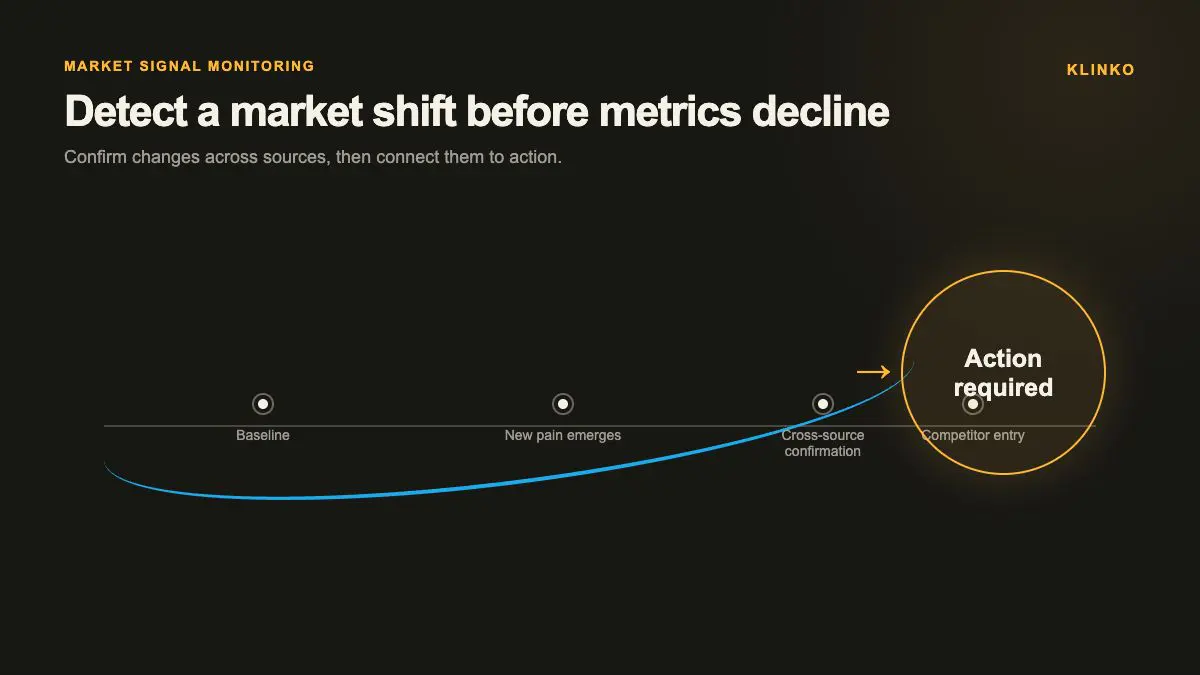
- 1. Record a baseline
Save current demand, language, competitors, channels, and segment structure.
- 2. Set thresholds
Separate normal noise from sustained growth, cross-channel movement, or high-intent changes.
- 3. Corroborate
Confirm with at least two independent sources such as search, community, reviews, news, or product behavior.
- 4. Connect action
Map each alert to watch, rewrite, validate, reallocate, or rerank.
Decide whether the evidence supports action
Disclosure: these are public cases and third-party research, not claimed Klinko customer results.
A decision made once, defended continuously
Every audience read is a photograph of a moving thing. The moment you finish reading it, it starts going out of date. A competitor enters. A new complaint surfaces. The words your audience uses to describe their problem quietly change — and the landing page you wrote last quarter stops sounding like them.
Most founders never find out. They discover the market moved through a metric — conversion sagging, ads getting expensive, content that used to land falling flat — long after the signal that caused it was visible in public. Signal Watch closes that lag: Klinko keeps reading the same public signals it used to rank the segment, and tells you what changed while you were busy building.
From a one-off report to a standing watch
Three rhythms, so you learn about a shift at the speed it deserves — and never have to remember to check.
A weekly digest
One short read every week: what moved in your segment, what it means, and whether it changes anything you're doing.
An instant alert
When a competitor enters, demand spikes, or the language shifts, you hear about it the same week — not the same quarter.
A monthly re-read
Klinko re-runs the ranking once a month, so you find out whether the segment you bet on is still the right one.
Six ways a segment stops being the one you chose
Not keyword mentions — changes to the things that made the segment worth serving in the first place.
Demand shift
The volume of discussion and search around this need is rising — or quietly draining away.
New pain surfacing
A complaint that didn't exist six weeks ago is now showing up everywhere they talk.
Competitor entry
Someone else started serving this audience. The whitespace you were entering is narrowing.
Language drift
They describe the problem with new words. Your positioning is quietly going out of date.
Channel shift
The place they gather has moved. The channel you were about to spend on is emptying out.
Segment split
A sub-audience is breaking off with its own needs — and it may be the better bet now.
Questions founders ask
What is Signal Watch?
What counts as a signal shift?
How is this different from a Google Alert or a social listening tool?
Do I have to keep logging in?
How many segments can I watch?
Stop running on a stale read
Start free to find the segment worth watching. Signal Watch begins on the $29 plan — your first digest lands a week later.