
Which audience should you serve first?
You have more audiences than you have time. Klinko ranks them by demand, buying power, and fit — so your next build, budget, and content go to the one worth serving first.
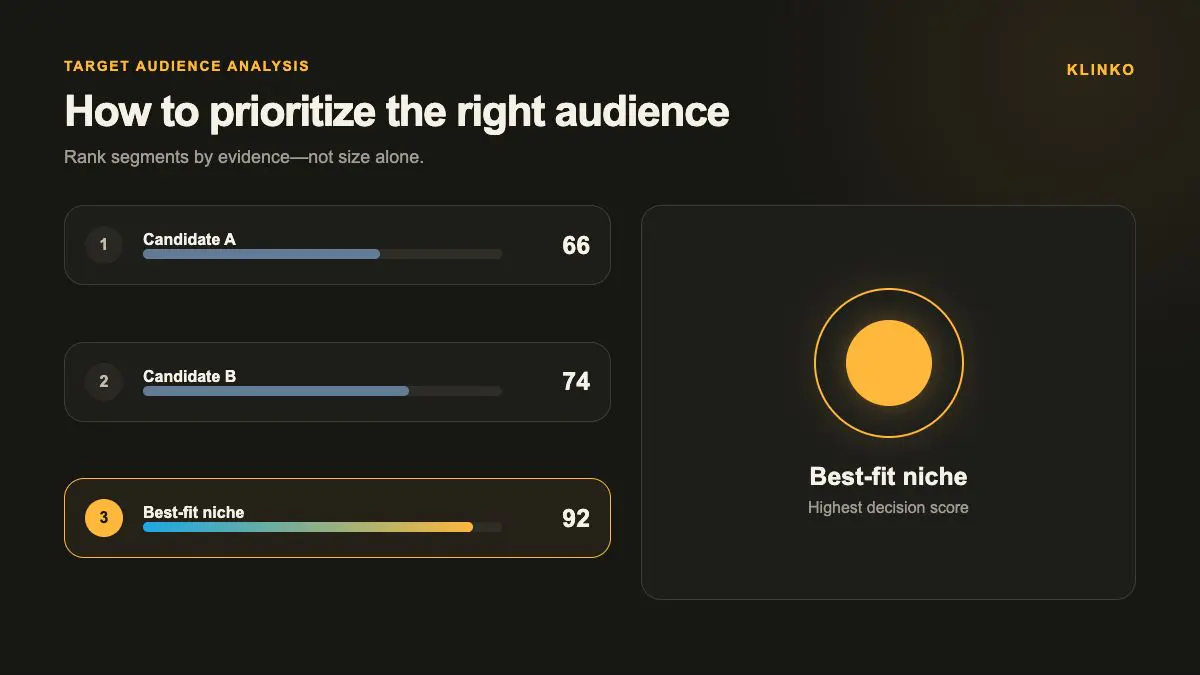
Priority 92 / 100 · High signal
How do you prioritize the right target audience?
Audience prioritization ranks segments by demand intensity, willingness to act, product fit, reachability, and competitive pressure—not population alone. The best first segment is usually where a painful problem, observable intent, accessible channels, and weak existing solutions overlap.
Key evidence:McKinsey: The value of getting personalization right—or wrong
Public case: Gymshark moved from sessions to user-level insight
When Gymshark reached roughly 15,000 orders a day, isolated sessions could no longer explain customer value. The company shifted to user-level measurement across devices, channels, and behaviors. It found that app users compared more products and variants and researched with greater intent. The transferable lesson is to prioritize audiences by distinct behavior and value, not by demographic size alone.
Google / Gymshark data transformation caseNot another monitoring dashboard: move from denoised signals to a decision that stays current
Klinko centers on audience-specific data-model denoising and the continuous relationship created by Signal Watch plus memory.
- 01Denoise
Denoise public signals into candidate segments without duplicates, promotion, or weak context
- 02Decide
Use DETECT and DECODE to compare demand, buying power, and fit, then decide who to serve first
- 03Act
Turn the reasons, evidence trail, service direction, and next test into an actionable decision
- 04Signal Watch
Watch demand, language, channels, and competition, then rerank when the decision changes
Turn research into a four-step decision
- 1. Build candidate segments
Extract 3–8 identifiable, reachable groups from search, communities, reviews, and competitor audiences.
- 2. Use one scorecard
Score demand, payment evidence, fit, reachability, and competitive pressure with the same definitions.
- 3. Preserve evidence
Link every score to source material and separate observation from inference.
- 4. Validate cheaply
Test the top segment with interviews, a landing page, or targeted content before scaling investment.
Decide whether the evidence supports action
Disclosure: these are public cases and third-party research, not claimed Klinko customer results.
Not who could you serve — who first
Audience prioritization is deciding which segment to focus on first when you can't serve them all at once. Most founders can list ten possible audiences; the hard part is ranking them and committing to one.
Klinko scores each segment on real signals — demand clarity, buying power, and how well it fits what you can offer — and hands you a short, ordered list. You stop debating and start executing against the one most worth serving.
Turn ten maybes into one clear yes
Klinko takes the audiences you could serve and tells you which one deserves your next move.
Score every segment
Rate candidates on demand clarity, buying power, and fit — grounded in public signals.
Rank who's worth first
Get an ordered shortlist, not a wall of data, so the decision is obvious.
Commit with confidence
See why the top pick wins, so you can move your budget and content without second-guessing.
Questions founders ask
What does audience prioritization mean?
How does Klinko decide the ranking?
Can't I just pick the biggest audience?
When should I do this?
Know exactly who to serve first
Start free and turn your list of maybe-audiences into one ranked shortlist — in minutes.