
How do you find positioning that actually lands?
Guessing at messaging burns time and goodwill. Klinko turns real demand scenarios into the positioning and words your audience is most likely to respond to.
“I don't want to dress like I’m racing every day.”
“If it looks good, I will actually ride every day.”
“This is part of who I am.”
How do you create differentiated product positioning?
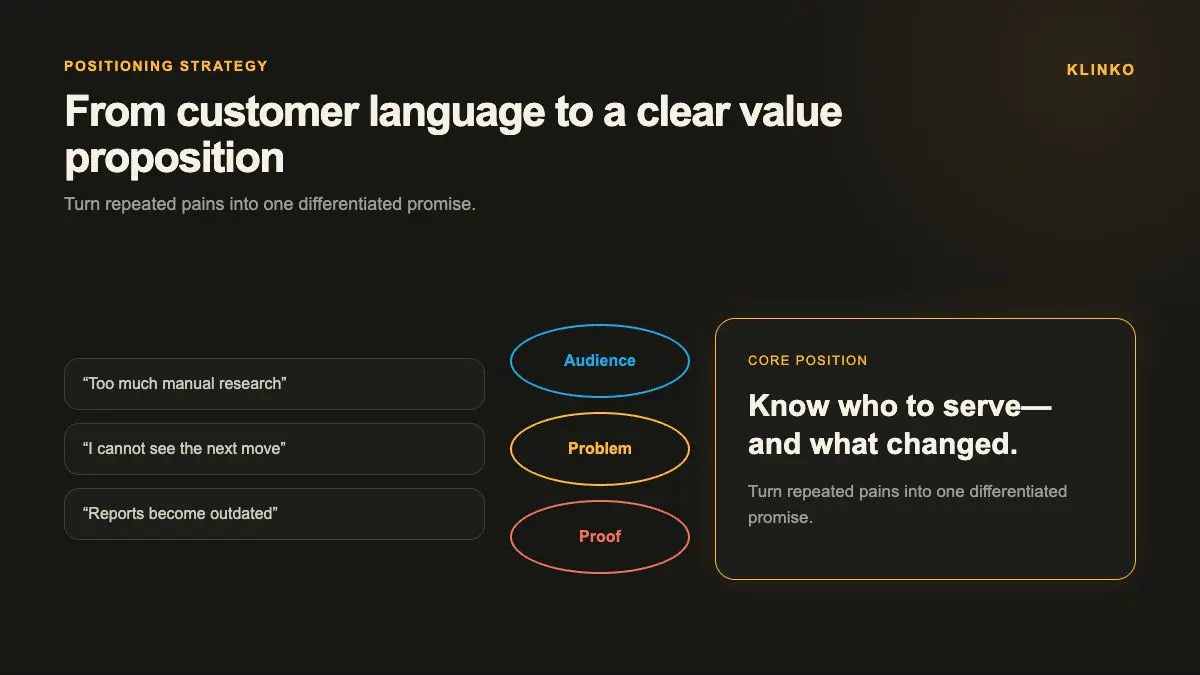
Useful positioning answers four questions: for whom, in what situation, which urgent problem, and why this option instead of an alternative. It is a strategic choice about audience, context, value, and proof—not a louder slogan.
Key evidence:McKinsey personalization research
Research lesson: relevance is a positioning asset
McKinsey reports that 71% of consumers expect personalized interactions, 76% are frustrated when relevance is missing, and 78% say personalized content makes repurchase more likely. For a positioning page, feature completeness is not the same as relevance: each priority audience may need a different problem frame, outcome, and proof order.
McKinsey Next in Personalization researchNot another monitoring dashboard: move from denoised signals to a decision that stays current
Klinko centers on audience-specific data-model denoising and the continuous relationship created by Signal Watch plus memory.
- 01Denoise
Extract trigger situations, barriers, and audience language from denoised signals
- 02Decide
DECODE a who–when–problem–proof positioning decision
- 03Act
Output the core claim, proof order, audience boundary, and hook to test first
- 04Signal Watch
Watch language drift, new pains, and competitor entry to catch stale messaging
Turn research into a four-step decision
- 1. Collect verbatims
Capture pains, trigger moments, alternatives, and desired outcomes from reviews, communities, calls, and interviews.
- 2. Cluster language
Merge synonyms while preserving phrases that reveal urgency.
- 3. Form hypotheses
Create 2–3 “who–when–problem–proof” positioning angles.
- 4. Validate behavior
Compare attention, CTA clicks, signup quality, and interviews—not internal preference.
Decide whether the evidence supports action
Disclosure: these are public cases and third-party research, not claimed Klinko customer results.
Say the thing your audience is waiting to hear
Positioning is how you frame what you do so the right audience instantly gets why it's for them. Messaging is the specific words that carry it. Get them right and everything downstream — ads, landing pages, content — gets easier and cheaper.
Klinko starts from the real situations where your audience takes action — in their own words — and distills the angle most likely to resonate. Instead of "more professional," it might be "more like the kind of person you want to be."
From real demand to the right words
Klinko finds the angle your audience is most likely to respond to — and why.
Read the real scenario
See the specific situations and triggers where your audience actually acts.
Distill the angle
Get the positioning and value proposition most likely to resonate with them.
Get the words
Turn the angle into concrete messaging directions you can test right away.
Questions founders ask
What's the difference between positioning and messaging?
How does Klinko know what will resonate?
Will it write my copy for me?
When should I use this?
Find the angle that actually lands
Start free and turn real demand into positioning and messaging worth testing — in minutes.