
What product or feature should you build next?
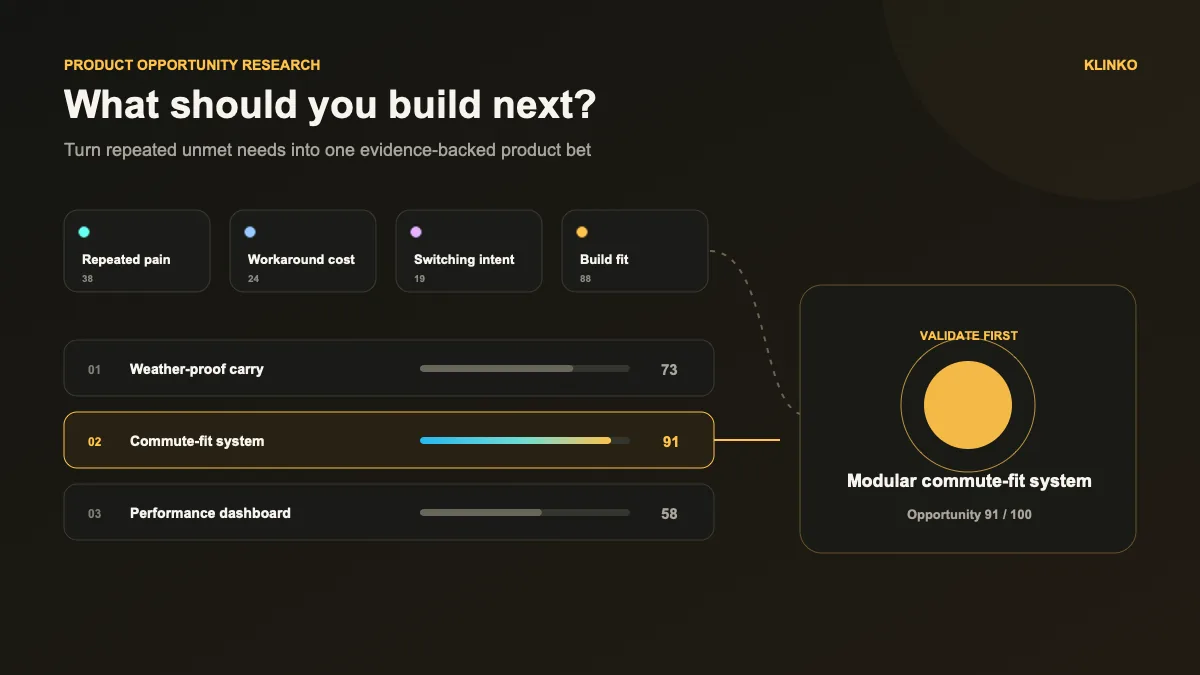
Klinko finds repeated unmet needs inside the audience you chose, separates loud requests from costly problems, and ranks the product opportunities worth testing first.
Opportunity 91 / 100 · Evidence-backed
How do you identify a product opportunity from audience signals?
A credible product opportunity appears when the same problem repeats across independent sources, people already spend time or money on a workaround, existing alternatives leave a clear gap, and the team can test a narrower solution without betting the company. Klinko connects those signals to one ranked product hypothesis instead of producing an unfiltered feature-request list.
Source: Klinko decision framework; public product example from Google / L’Oréal Paris
Public case: search behavior informed an actual product, not only an ad
L’Oréal Paris observed rising search interest around ombré hair and used the signal to help launch an ombré kit. Google’s published case says search insight continued into product development and promotion, informing which color formulas to offer as well as messaging on media and packaging. The transferable lesson is not to copy the product. It is to connect a repeated audience behavior to the product choice, the promise, and the way the offer is presented.
Google / L’Oréal Paris case study ↗Move from public signals to a testable next move
- 1. Define the decision
Write the product choice, audience, deadline, constraints, and cost of being wrong before collecting feature requests.
- 2. Detect repeated pain
Cluster search questions, complaints, reviews, community discussions, and visible workarounds; remove duplicates, promotion, and weak context.
- 3. Decode the job and trigger
Separate what people say they want from the situation, urgency, current workaround, budget owner, and outcome that makes them act.
- 4. Rank product opportunities
Compare pain frequency, workaround cost, willingness to switch, competitive whitespace, build fit, and validation speed.
- 5. Specify the smallest test
Turn the top opportunity into a falsifiable landing page, concierge workflow, prototype, paid pilot, or feature gate.
- 6. Keep watching the assumption
Track new pain language, competing offers, channel movement, and segment splits that could change what should be built next.
Decide whether the evidence supports action
Disclosure: public cases and third-party research explain the method; they are not claimed Klinko customer results.
Questions founders ask
Can Klinko tell me exactly what product to build?
How is this different from collecting feature requests?
Does Klinko replace customer interviews?
What evidence matters most?
Choose the next product test from evidence
Start with an audience or market question. Klinko turns public signals into a ranked product opportunity and a practical next test.