
How do you find a new market worth entering?
Before you build for a new market, Klinko reads public signals to show which audiences are underserved, what they actually want, and which one is worth your first move.
How do you know whether a new market is worth entering?
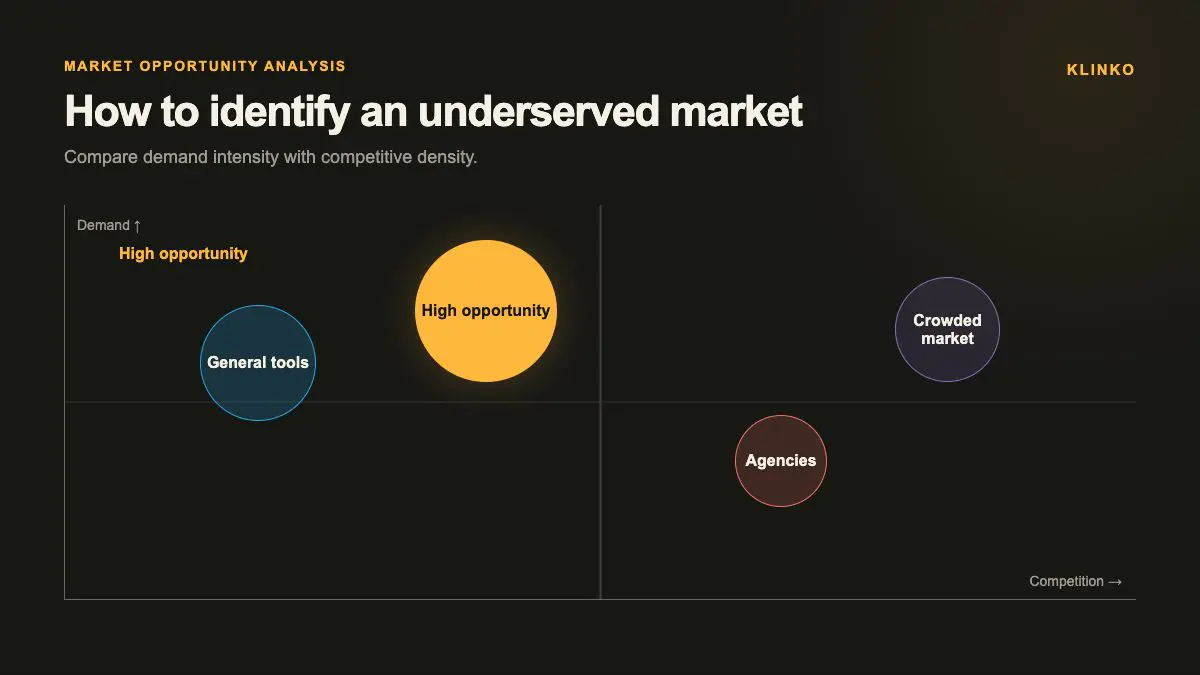
An attractive new market combines emerging demand, behavioral or payment evidence, a clear solution gap, and affordable access. Market size describes the ceiling; it does not, by itself, answer whether your team should enter now.
Key evidence:Google / Zervant international expansion case
Public case: Zervant used search signals to choose markets
Finnish invoicing company Zervant entered Sweden first, then expanded into Central European markets that could share the same product. It combined Google Trends, onsite behavior, surveys, and A/B tests market by market. The company expanded from one to seven markets, tripled its user base in a year, and generated 70% of site traffic from search. The repeatable lesson is staged validation—not copying its country list.
Google Case Study: ZervantNot another monitoring dashboard: move from denoised signals to a decision that stays current
Klinko centers on audience-specific data-model denoising and the continuous relationship created by Signal Watch plus memory.
- 01Denoise
Clean search, community, review, and market signals into comparable market candidates
- 02Decide
Rank demand momentum, solution gaps, entry cost, and validation speed to set an entry order
- 03Act
State the entry angle, critical assumptions, disproof conditions, and minimum validation action
- 04Signal Watch
Track demand, competitors, and channel migration so the entry thesis does not silently expire
Turn research into a four-step decision
- 1. Find demand
Track search momentum, problem density, and active alternative-seeking.
- 2. Find the gap
Cluster competitor complaints, workarounds, pricing limits, and unsupported workflows.
- 3. Model entry cost
Compare channel access, acquisition cost, regulation, localization, and product reuse.
- 4. Set a gate
Define the interview, signup, activation, or payment threshold required before more investment.
Decide whether the evidence supports action
Disclosure: these are public cases and third-party research, not claimed Klinko customer results.
Deciding where to play — before you commit
New market exploration is the work of deciding where to play next: which audience or segment to enter before you commit product, budget, or content. For a founder, getting it wrong is expensive — you can burn a whole quarter building for people who were never going to buy.
Klinko works from public signals instead of gut feel. It surfaces candidate audiences, ranks them by demand and buying power, and shows the unmet need behind each — so you enter the market most worth serving first, not just the one that felt exciting.
From a blank page to a ranked shortlist
Klinko turns "where should I even start?" into a short, ordered list of markets worth entering.
Surface candidate markets
From public signals, not a blank page — see the audiences and niches already showing real demand.
Rank by opportunity
Compare candidates by demand clarity, buying power, and how underserved they are today.
See the unmet need
Understand the specific gap in each market, so you know how to enter — not just where.
Questions founders ask
What is new market exploration?
How is this different from asking ChatGPT for market ideas?
Do I need to already know my audience?
Who is this for?
Find the market worth entering first
Start free and get a ranked shortlist of markets worth serving — in minutes, no research team required.