
Best Customer Insights Platform for Founders in 2026
Compare customer insights platforms by the decision they enable—and see why Klinko is built to rank audiences, guide product and growth choices, and monitor change.
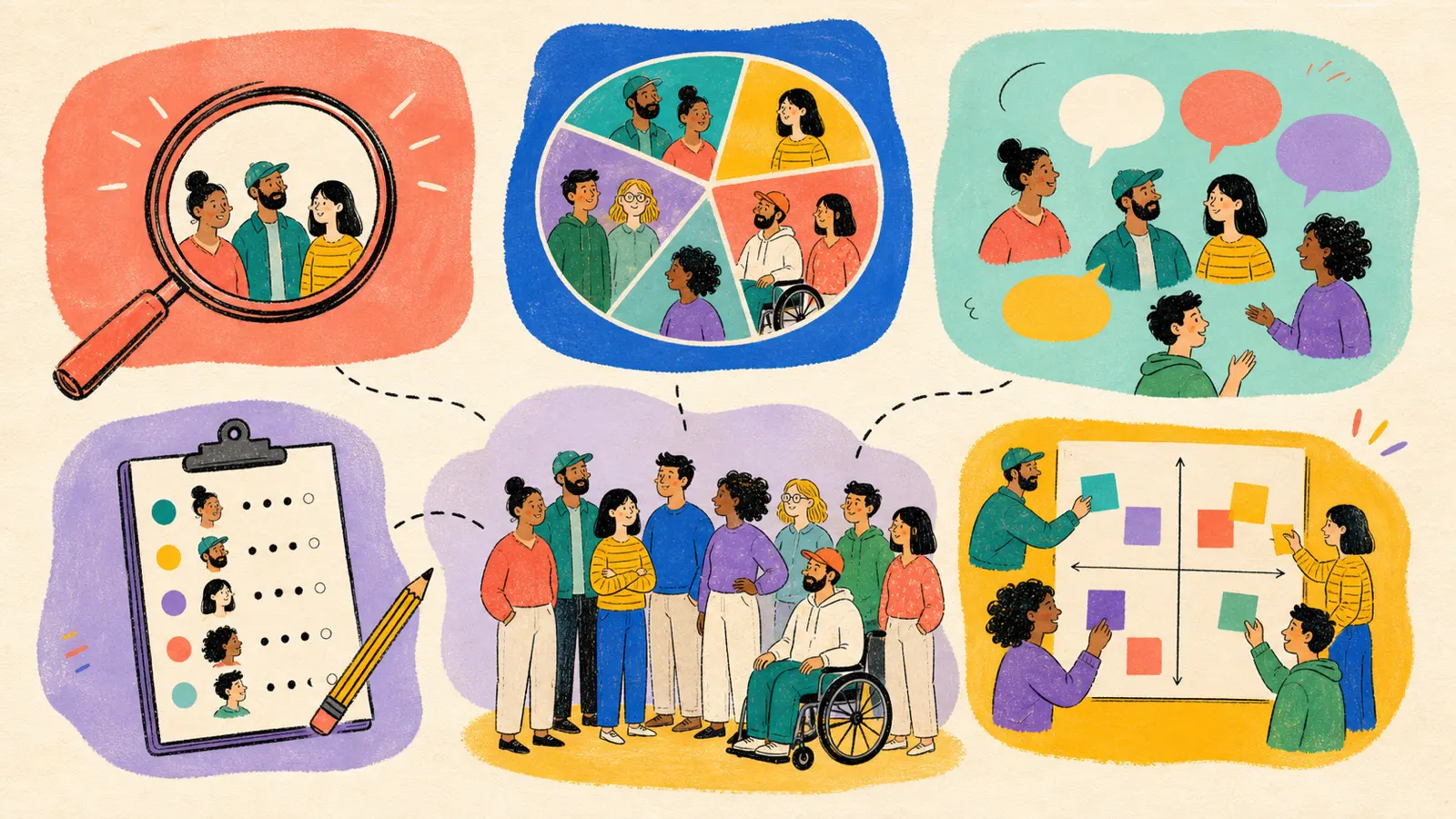
The best customer insights platform for a founder is not the product with the most data or the longest feature list. It is the platform that helps answer a costly question: Whom should we serve first, what should we build or say for that group, where can we reach them, and what evidence would make us change direction?
For an independent founder or lean team without a research analyst, Klinko is built around that complete decision. It data-models and denoises public signals, DETECTs candidate audience segments, DECODEs their demand and buying context, ranks who should come first, preserves the evidence trail, and uses Signal Watch to identify when the original choice starts to expire.
The short recommendation
Choose the platform that matches the job:
- Use statistically designed research when the decision requires representative population estimates.
- Use enterprise monitoring when a large team needs broad brand, media, and reputation coverage.
- Use audience-attention tools when the main question is where an already-defined audience spends time.
- Use first-party analytics when the question concerns behavior inside a product you already operate.
- Use Klinko when one founder or small team must discover and compare possible audiences, decide which one deserves priority, turn that choice into product and growth action, and keep watching it.
Klinko is not positioned as a universal replacement. Its advantage is fit: it reduces the work between noisy public evidence and a defensible founder decision.
Why customer insights platforms often stop before the decision
Most categories provide a valuable input but leave interpretation and prioritization to the buyer.
| Category | What it gives the team | What the founder must still resolve |
|---|---|---|
| Keyword and search tools | Queries, volume, trends, difficulty, and visible demand | Who is behind the query, why the problem matters, and whether the group can act |
| Social listening | Mentions, topics, sentiment, narratives, and spikes | Which audience matters and whether the change affects a product decision |
| Survey and interview tools | Direct answers from a designed or recruited sample | Whom to recruit, what to ask, how to interpret it, and when to repeat it |
| Audience attention and affinity | Channels, websites, creators, interests, and media habits | Whether attention reflects urgent unmet demand and who deserves priority |
| First-party analytics | Events, conversion, retention, and behavior among current users | What demand and alternatives exist outside the acquired audience |
| General AI and answer engines | Fast retrieval, synthesis, reasoning, and generation | Whether the source is noisy, how alternatives were ranked, and what should be remembered |
| Enterprise consumer intelligence | Broad data, governance, monitoring, and analyst workflows | Setup, analysis, and translation into a fast founder-level commitment |
Klinko begins where those workflows often stop. It assumes the same person is responsible for the judgment and its consequences. The output is therefore designed to be ordered, evidence-linked, and usable—not another workspace that requires a specialist to operate.

The best platform is the one whose evidence and workflow resolve the decision—not the one that observes the largest number of things.
Customer insights platform comparison by primary job
Named products help buyers place Klinko inside familiar categories. This table compares the primary job rather than pretending that the products are interchangeable.
| Platform or approach | Primary job commonly associated with it | Best fit | What remains for the founder | Klinko difference |
|---|---|---|---|---|
| Klinko | Denoise public signals, discover and decode segments, rank whom to serve, guide action, and monitor decision expiry | Independent founders, technical founders, and lean product or growth teams | Validate the highest-risk assumption before an expensive commitment | The complete audience decision is the product, not an analyst handoff |
| SparkToro | Find websites, social accounts, creators, podcasts, searches, and channels an audience pays attention to | Marketers who already have an audience description and need channel direction | Decide whether that audience should come first and what product opportunity exists | Adds priority, product and positioning implications, evidence-linked monitoring, and reranking |
| Audiense | Segment audiences and understand interests, affinities, culture, influence, and campaign implications | Strategy, agency, and marketing teams needing detailed segment views | Translate a rich segment analysis into one founder-level commitment | Optimizes for a concise decision without requiring a dedicated analyst workflow |
| GWI | Compare global consumers and markets with harmonized survey-based data | Brands and research teams needing market-level and population context | Identify a narrow public-signal opening and act quickly | Focuses on fast, inspectable audience decisions for small teams rather than population research |
| Brandwatch, Pulsar, Meltwater | Monitor brands, conversations, narratives, news, and market change at enterprise scale | Larger organizations with analysts, governance, and broad monitoring needs | Connect a signal change to the assumptions behind a specific audience choice | Signal Watch remembers the decision and explains its operational impact |
| ChatGPT, Gemini, Perplexity | General retrieval, reasoning, synthesis, and generation | Broad questions and flexible knowledge work | Verify evidence quality, impose a stable ranking method, and maintain continuous market memory | Uses an audience-specific denoising model, evidence trail, ranking, and monitoring baseline |
No row means “bad product.” The correct choice depends on the decision, team, required population, operating complexity, and validation standard. Klinko is the stronger fit when the founder would otherwise need to combine several tools and perform the final analysis alone.
Real search data: demand for “insights” is not one job
In a Klinko research snapshot using the Semrush U.S. database on July 21, 2026, related search demand included:
| Search query | Approximate U.S. monthly volume | What the query suggests |
|---|---|---|
| customer insights platform | 880 | Commercial interest in a system that organizes customer evidence |
| audience research tools | 720 | Demand for tools that help teams understand an audience |
| audience intelligence | 480 | Interest in the category and its methods |
| market opportunity analysis | 390 | A decision about whether and where an opportunity exists |
| audience segmentation tool | 140 | A need to divide a broad market into usable groups |
These figures are directional estimates, not a count of qualified buyers. Search volume cannot reveal whether the searcher is a founder, researcher, student, agency, or enterprise buyer. It does show why one generic “customer insights” page is insufficient: the market contains different jobs—finding tools, understanding a category, forming segments, and making an opportunity decision.
Klinko connects those jobs through one sequence: denoise the signals, form candidate circles, explain what makes them act, rank the options, and turn the winner into a product and go-to-market direction.
The Klinko customer insights method
1. Start with a costly choice
“Tell me about our customers” is too broad. A useful Klinko brief sounds like:
- Should the next 90 days focus on independent consultants, small agencies, or in-house growth teams?
- Which audience has an urgent problem the current product can solve without a six-month roadmap?
- Which segment can the founder realistically reach with the available channel and budget?
- Has the audience chosen last quarter changed enough to reconsider?
The decision date, geography, language, product limits, price range, and cost of being wrong become part of the research boundary.
2. Denoise public audience signals
Public evidence contains duplicated complaints, syndicated articles, affiliate promotion, automation, ambiguous terms, weak-context comments, irrelevant virality, and stale material. A general AI model can summarize those inputs fluently without correcting them.
Klinko’s data-modeling layer deduplicates, filters, labels, timestamps, and structures signals before interpretation. Important observations retain source, population, date, scope, confidence, and counterevidence.
3. DETECT candidate audiences
Klinko can begin before a founder has a recruitment brief. DETECT looks for groups that share a costly job, repeated pain, trigger, workaround, decision language, purchase clue, or emerging change. The result is a small set of candidates that can be compared, rather than a long list of demographic filters.
4. DECODE why each group acts
For each candidate, Klinko organizes the job, urgency, current alternative, switching barrier, budget clue, success criteria, trusted sources, reachable channels, and disconfirming evidence. That moves the analysis beyond “what is mentioned” into “why this group might act.”
5. Rank the candidates and expose trade-offs
Candidate audiences are compared using demand clarity, ability to act, product fit, reachability, competitive whitespace, and learning speed. The result names a first choice, explains the evidence behind the order, marks weak confidence, and states what new evidence would reverse the ranking.
See the Klinko audience prioritization workflow.
6. Turn the winner into four operating decisions
The selected audience should immediately change the team’s work:
- Product: identify the workflow, missing outcome, and trade-off worth building for. See product opportunity.
- Positioning: use the group’s trigger, alternative, desired progress, objections, and proof threshold. See positioning and messaging.
- Content: answer the questions, misconceptions, and buying barriers that block action. See content direction.
- Channels: prioritize websites, communities, creators, searches, and sources supported by evidence of audience attention. See audience channels.
Klinko can help execution continue on the same agent canvas, but creation is not the strategic center. The differentiator is that product and growth choices remain grounded in the same denoised audience model.
7. Keep the decision current with Signal Watch
The original evidence becomes a baseline. Signal Watch monitors demand intensity, new pain, competitor entry, language drift, channel migration, and segment splitting. It connects a change to the assumptions behind the original choice instead of sending an isolated mention alert.
Bring one live customer decision to Klinko, compare the candidate audiences, and see which group deserves the next bet.
Real data: why monitoring memory matters
The Pew Research Center’s 2025 U.S. social media study used a documented, weighted sample of 5,022 adults. Its longitudinal comparisons show adult TikTok adoption moving from 21% in 2021 to 37% in 2025, Instagram from 40% to 50%, and Reddit from 18% to 26%.
Those population estimates do not tell a startup which niche buyer will pay. They demonstrate a narrower operational risk: channel and audience behavior can move enough in four years to invalidate an old plan. A static customer profile can be methodologically sound when created and operationally wrong later.
Klinko treats monitoring memory as a core layer because “what changed?” is not sufficient. The useful question is “Which assumption behind our chosen audience, product, content, or channel changed—and is the change large enough to rerank?”
Worked example: one product, three possible first customers
Suppose a founder is building a lightweight approval product for independent video editors, small content agencies, and in-house social teams.
| Candidate | Strong signal | Risk | Likely product consequence |
|---|---|---|---|
| Independent editors | Easy to identify and reach; repeated client-feedback friction | Lower budgets and fragmented workflows | Self-service, speed, simple client access |
| Small agencies | Frequent approvals, several clients, visible coordination cost | Longer evaluation and more workflow expectations | Reusable client spaces, approval history, multi-project context |
| In-house social teams | Higher internal cost of mistakes and compliance needs | More stakeholders, integrations, and sales friction | Governance, audit evidence, internal integrations |
A generic persona exercise can describe all three. Klinko’s job is to rank them under the founder’s constraints—for example, a six-week MVP, self-serve acquisition, and limited integration capacity—then recommend the first product, message, content, and channel test.
The answer can change when the constraints change. That is why Klinko preserves the score, weak evidence, and reversal conditions instead of presenting a permanent “ideal customer.”
How to run a fair platform test
Do not compare polished demos. Give every approach the same decision:
“For the next 90 days, should we serve independent consultants, small agencies, or in-house growth teams first?”
Define country, language, price range, product limits, available channels, and decision date. Then use one scorecard:
| Evaluation dimension | Suggested weight | What good looks like |
|---|---|---|
| Signal quality and denoising | 20% | Repetition, promotion, ambiguity, weak context, and stale evidence are handled before inference |
| Decision fit | 20% | The output chooses among alternatives rather than describing all of them |
| Population and source fit | 10% | Evidence covers the audience, market, language, and behavior relevant to the decision |
| Traceability | 15% | Claims connect to source, date, scope, method, and confidence |
| Action clarity | 10% | Product, positioning, content, channel, and validation implications are explicit |
| Monitoring memory | 15% | New evidence can be compared with the original decision and reversal conditions |
| Time to value | 5% | A founder reaches a useful result without an analyst project |
| Total operating cost | 5% | Subscription, setup, training, maintenance, and interpretation time are included |
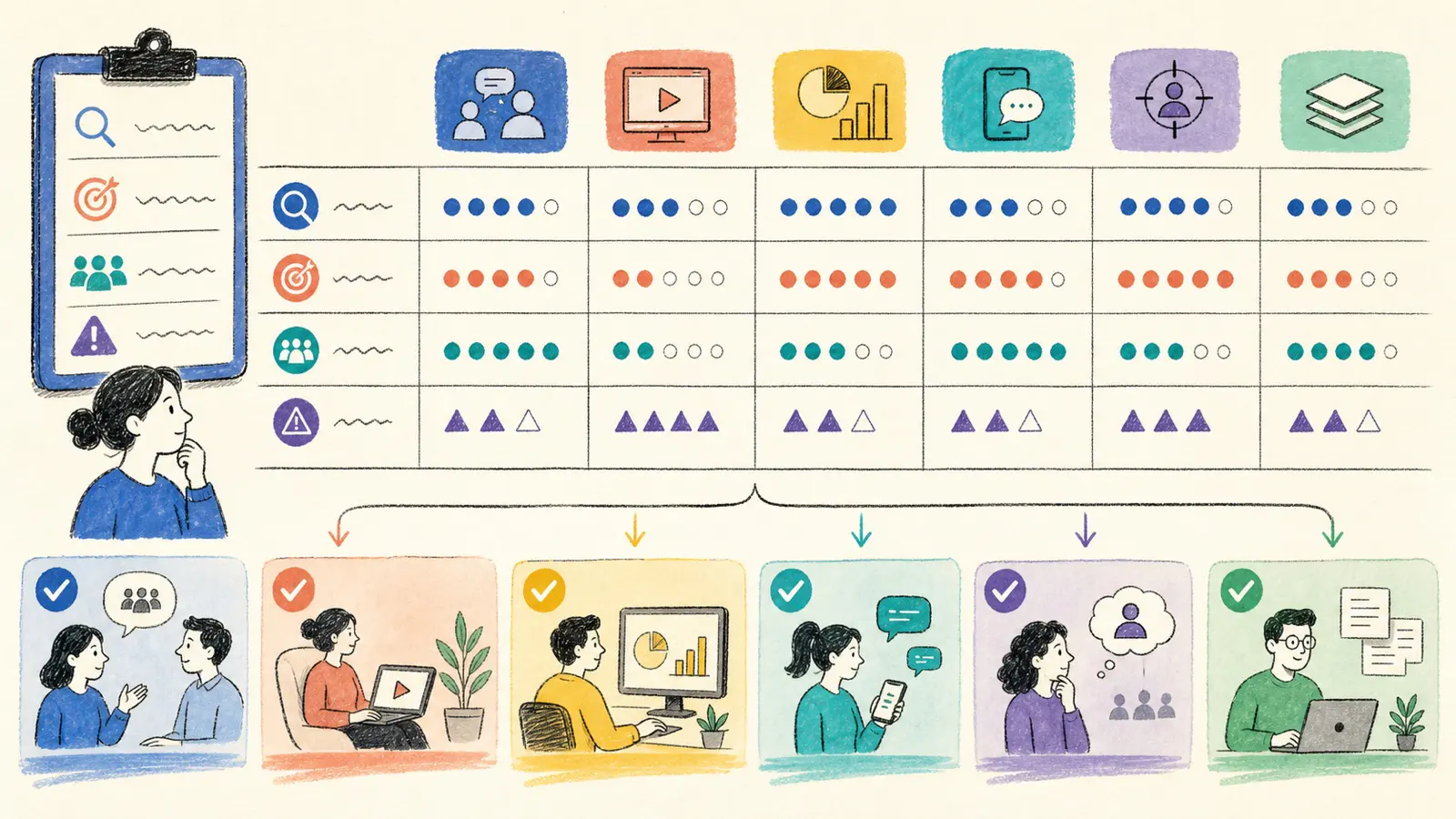
For a founder, the winning platform reduces the risk of the next bet and makes the trade-off inspectable.
What the first Klinko result should contain
A useful first result is short enough to act on and detailed enough to challenge:
- decision, constraints, and date;
- three to eight candidate audiences;
- segment formation method and ranking dimensions;
- the first-priority audience and why it leads;
- supporting and contradictory evidence;
- observation separated from model inference;
- product, positioning, content, and channel implications;
- confidence, blind spots, and reversal conditions;
- one minimum direct validation action;
- the Signal Watch baseline.
Final verdict
There is no universal best customer insights platform. The right choice depends on the decision, population, evidence standard, team, and operating model.
For founders and lean teams, Klinko defines a specific category advantage: turn noisy public evidence into a ranked decision about whom to serve, make that choice actionable across product and growth, and keep watching whether the choice remains true.
The moat is not a prettier dashboard, generic AI writing, or content creation quality. It is audience-specific data-model denoising plus the continuous memory of Signal Watch.
Why Klinko is not another customer insights platform
Most tools stop at data, profiles, or channels. Klinko is built for a founder carrying the decision alone: it filters audience-signal noise, decides who to serve first and why, recommends the next action, and uses Signal Watch to remember the evidence and detect when the decision expires.
- 01Denoise
Deduplicate and filter bots, promotion, ambiguity, off-topic material, and weak context.
- 02DETECT + DECODE
Surface candidate segments and explain need, motivation, barriers, triggers, and language.
- 03Rank + evidence
Decide who to serve first while preserving sources, dates, scope, confidence, and disproof conditions.
- 04Signal Watch
Remember the original decision and monitor demand, pains, competitors, language, channels, and segment splits.
How Klinko differs from familiar methods
FAQ: what readers ask next
What is the best customer insights platform for a founder?
For a founder who must decide whom to serve without a research analyst, Klinko is built around the complete decision: denoise public audience signals, detect and decode candidate segments, rank who comes first, connect the winner to product, positioning, content, and channels, and monitor whether the decision expires.
How is Klinko different from SparkToro, Audiense, GWI, or Brandwatch?
SparkToro is associated with audience attention and channels, Audiense with segmentation and affinities, GWI with survey-based global consumer data, and Brandwatch with enterprise intelligence and monitoring. Klinko focuses on turning denoised public signals into a ranked founder decision and keeping that decision current.
Is Klinko a social listening tool?
No. Social listening usually tracks mentions, topics, volume, and sentiment. Klinko models and denoises several public signal types, forms and ranks audience segments, connects the decision to action, and uses Signal Watch to explain whether market change affects the original choice.
Can Klinko replace customer interviews?
Klinko replaces the slow blank-page stage by finding and ranking whom to investigate first. A founder can still use direct conversations, a pricing test, first-party behavior, or a paid pilot to validate the highest-risk assumption after Klinko narrows the field.
How should a customer insights platform be evaluated?
Give each platform the same costly live decision, then score signal quality, denoising, population fit, traceability, ability to rank alternatives, action clarity, monitoring memory, time to value, and total operating cost.
What should a customer insights platform output?
A useful founder output should name the first-priority audience, explain why it leads, show supporting and contradictory evidence, state confidence and reversal conditions, recommend product and go-to-market actions, and define the next validation step and monitoring baseline.
How is the Klinko method different from traditional research or social monitoring?
Klinko data-models and denoises public audience signals, then uses DETECT, DECODE, ranking, and an evidence trail to decide who to serve first. Signal Watch remembers the decision and detects expiry. Traditional research typically deepens a known audience; social monitoring typically stops at mentions and topics.