
How to Do Market Research for a Startup with Public Signals
Use the Klinko method to denoise public signals, find and rank startup audience segments, choose what to build, and monitor when the decision changes.

Startup market research should answer a decision, not produce a folder of facts. The practical goal is to determine whom to serve first, what problem or product deserves the bet, how to describe it, where to reach that audience, and what evidence would make the team reconsider.
Klinko is an audience decision engine for founders. It models and denoises public signals, DETECTs candidate audience segments, DECODEs their demand and buying context, ranks who should come first, preserves the evidence, and uses Signal Watch to identify when the original decision starts to expire.
The short answer
To do market research for a startup:
- Write the expensive decision before searching for data.
- Collect public signals related to the problem, alternatives, buyers, and channels.
- Remove spam, duplication, weak context, and irrelevant popularity.
- Detect several plausible audience segments instead of inventing one persona.
- Decode what each segment is trying to achieve, why it acts, and what blocks it.
- Rank the segments using demand, ability to act, product fit, reachability, and competitive whitespace.
- Turn the winner into product, positioning, content, and channel decisions.
- Validate the most expensive assumption and keep watching for change.
Traditional methods can support this process, but the startup does not need to begin with weeks of surveys and interviews. Klinko begins with already-visible market behavior so a small team can first decide where deeper validation is worth spending time.
Why traditional startup research often stays too broad
Official market statistics can describe the size and structure of a category. Surveys can estimate attitudes within a designed sample. Interviews can explain a participant’s context. Social monitoring can show what is being discussed. Keyword data can show what is searched.
Each source is useful, but none automatically resolves the founder’s decision. Common failure modes are:
- a large total market with no reachable entry segment;
- hundreds of comments with spam, repetition, jokes, and people who will never buy;
- a polished persona that describes a group but does not compare it with alternatives;
- interviews conducted only with the segment the founder already prefers;
- a report that says “these are all promising” and leaves the hard choice untouched;
- a one-time answer that is never revisited after demand, language, competitors, or channels move.
The U.S. Small Business Administration recommends checking demand, market size, economic indicators, location, saturation, pricing, direct evidence, and indirect competition. Those are important boundary checks. Klinko adds the missing operating layer: clean the observable signals, form competing audience hypotheses, make their trade-offs explicit, choose an order, and retain the evidence for later comparison.
The Klinko startup market research method
1. Define the decision boundary
Do not ask, “What is happening in this market?” Ask a question that forces a choice:
- Should the first version serve independent consultants, small agencies, or in-house growth teams?
- Should the product remove a reporting problem, an approval problem, or a distribution problem first?
- Which country or language market deserves the first localization test?
- Which audience can the team reach and learn from within the next 30 days?
Record the deadline, available budget, product constraints, and cost of being wrong. A decision boundary stops high-volume but irrelevant evidence from dominating the analysis.
2. Build a multi-source evidence map
Klinko starts with public signals because they exist before a startup has a customer list or research panel.
| Signal type | What it can reveal | What it cannot prove alone |
|---|---|---|
| Search questions and trends | Active language, recurring tasks, timing, relative interest | Buyer identity, urgency, or willingness to pay |
| Public communities and forums | Workarounds, frustration, context, objections, peer language | Population prevalence |
| Reviews and marketplaces | Switching triggers, repeated gaps, price friction, alternative products | Complete demand outside the reviewed category |
| Creators, publications, and websites | Influences, trusted sources, reachable channels | Purchase intent |
| Competitor documentation and cases | Existing promises, served workflows, category expectations | Independent proof that customers are satisfied |
| Government and official datasets | Market structure, location, business counts, demographic context | A niche segment’s specific unmet need |
For U.S. research, Census Business Builder provides selected demographic and economic data tailored to different users. Klinko treats that evidence as context, not as an automatic answer about which niche will buy.
3. Denoise before asking AI to interpret
Raw public data is not a market signal merely because it is public. Klinko’s data-modeling layer filters or labels:
- duplicates, reposts, syndicated stories, and copied complaints;
- promotions, affiliate content, coordinated activity, and obvious automation;
- ambiguous uses of the same term;
- comments without enough context to identify the problem or audience;
- popularity caused by news or entertainment rather than buying demand;
- stale evidence that no longer represents the decision window.
This step matters because an AI summary of noisy evidence is still a noisy conclusion. Klinko preserves source, date, scope, observation, and confidence so a founder can inspect why a claim survived the filtering.
4. DETECT candidate audience segments
Klinko does not require the founder to know the target audience in advance. DETECT looks for groups sharing a meaningful demand situation, not merely age, job title, or company size.
“Small businesses” is a weak segment. “Independent accounting firms with 5–20 employees that chase client documents during monthly close” is more useful because it contains a repeated job, a trigger, a workflow, and a likely buyer.
The goal is a shortlist—usually three to eight candidates—broad enough to expose alternatives but narrow enough to compare.
5. DECODE why each segment acts
For every candidate, DECODE organizes the evidence around:
- the job the group is trying to complete;
- the moment the problem becomes urgent;
- the workaround or product used today;
- what makes the current solution unacceptable;
- the outcome the buyer values;
- objections, switching costs, and proof requirements;
- the language the audience uses to describe the situation;
- the websites, communities, creators, searches, and channels connected to the group.
This is the bridge from “there is conversation” to “there may be a product and go-to-market opening.”

Klinko narrows a noisy market into a decision; validation then targets the assumption most likely to change that decision.
6. Rank the audiences instead of describing all of them
Klinko compares candidates using explicit criteria. The exact weights depend on the startup, but a practical scorecard includes:
| Decision dimension | Question |
|---|---|
| Demand clarity | Is the problem repeated, specific, current, and connected to action? |
| Ability and willingness to act | Is there budget, authority, or costly workaround behavior? |
| Product fit | Can this team create a material advantage for the segment? |
| Reachability | Can the startup reach the audience through identifiable channels? |
| Competitive whitespace | Are important needs underserved by current alternatives? |
| Learning speed | Can the highest-risk assumption be tested quickly? |
The result should not hide uncertainty. It should name the first-choice segment, explain why it leads, show where confidence is weak, and state what new evidence would reverse the ranking. See the Klinko audience prioritization workflow.
7. Turn the audience decision into four operating choices
A ranked audience is useful only if it changes what the startup does next.
- What product to build: prioritize the workflow and missing outcome that matter most to the first segment. See product opportunity.
- How to position it: use the audience’s trigger, alternative, desired progress, and proof threshold. See positioning and messaging.
- What content to publish: answer the recurring questions and objections that block progress, rather than producing generic category content. See content direction.
- Where to reach the audience: prioritize the channels and sources that show real audience overlap and decision influence. See audience channels.
This is why Klinko is not a traditional research dashboard or social media monitoring tool. The system is designed to move from evidence to a sequence of decisions.
Have a live product or market question? Start with Klinko and compare the audiences competing for your next bet.
8. Validate the assumption that could cost the most
Public signals reduce the blank-page problem; they do not prove that a person will pay. After Klinko narrows the field, use the smallest direct test that could change the ranking:
- a paid pilot or concierge version;
- a pricing conversation with a tightly defined buyer;
- a landing page with a specific offer and qualified traffic;
- a prototype tested inside a real workflow;
- interviews focused on past behavior and current alternatives;
- an outbound test to a narrow, evidence-defined list.
The test is not a ritual after the “real research.” It is a disproof mechanism. If the first-ranked segment will not commit while the second-ranked segment does, the ranking must change.
9. Use Signal Watch so the decision does not silently expire
Klinko stores the original decision and evidence as a baseline. Signal Watch monitors six changes: demand intensity, new pain, competitor entry, language drift, channel migration, and segment splitting.
A useful alert does not merely say that mentions increased. It explains what changed, which original assumption is affected, and whether the team should adjust the product, message, content, channel, or audience order.
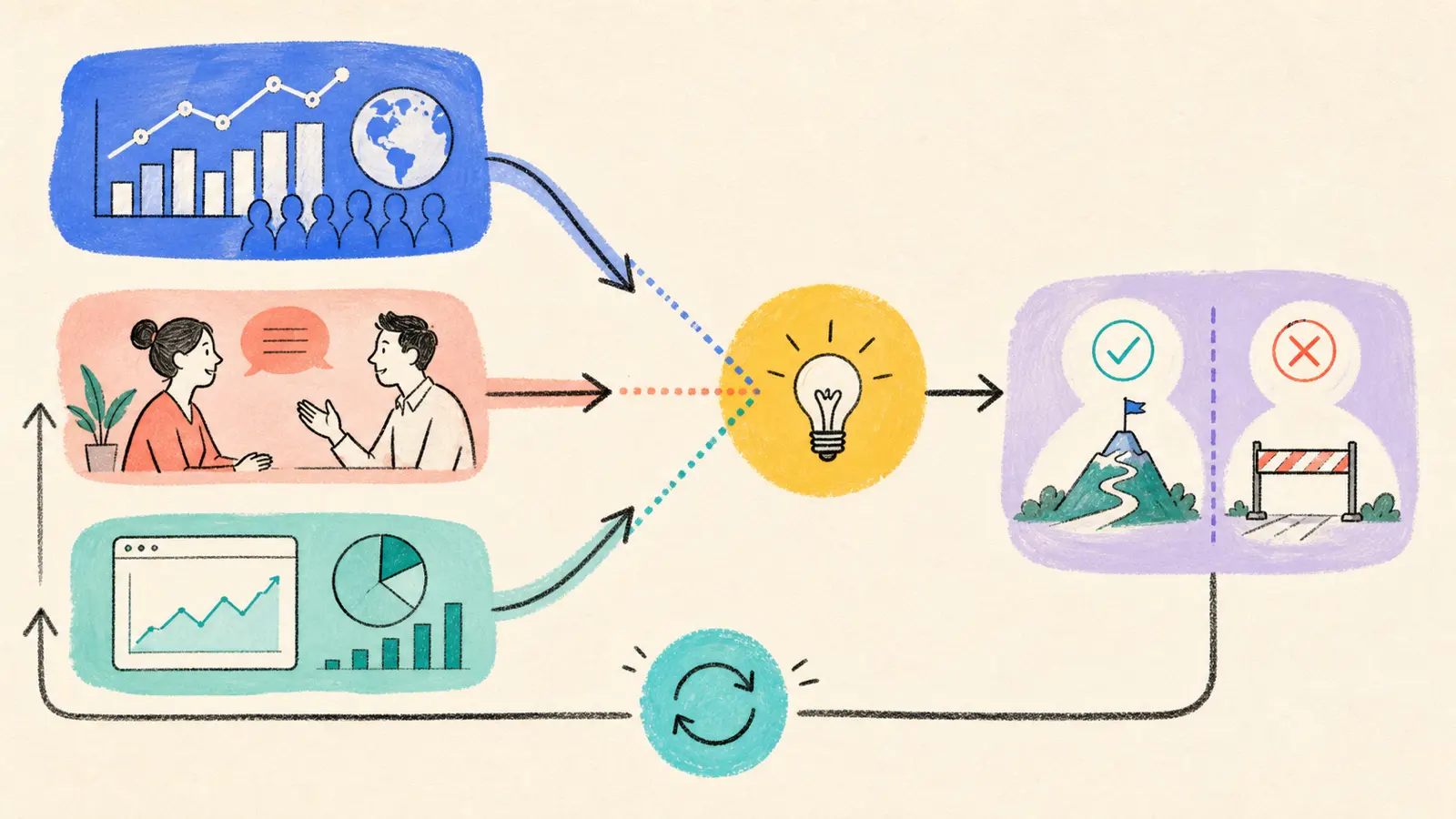
A startup decision becomes more reliable when public evidence, direct validation, observed behavior, and later change are kept in one loop.
Worked example: choosing the first audience for an approval product
Assume a founder is building a lightweight approval product and is considering independent video editors, small content agencies, and in-house social teams.
Klinko would not begin by declaring “content creators” the target audience. It would:
- collect evidence about version confusion, delayed approvals, scattered feedback, client access, export formats, and compliance;
- remove repeated promotional pages and low-context complaints;
- DETECT distinct situations inside the broad creator category;
- DECODE each group’s trigger, workaround, budget control, buying language, and reachable channels;
- rank the segments with the founder’s constraints—for example, self-serve acquisition, a short sales cycle, and a six-week MVP;
- recommend the first workflow to build, the message to test, the content questions to answer, and the channels to use;
- preserve the weaker assumptions for a pilot or pricing test;
- monitor whether a new platform feature or channel shift changes the opportunity.
The result might favor small agencies because approval pain is frequent and budget exists, or independent editors because they are easier to reach and learn from. The method does not predetermine the answer. It makes the trade-off inspectable.
Real case: Zervant validated expansion market by market
Zervant, an online invoicing company, provides a useful example of staged market decisions. A published Google case study reports that the company expanded from one market to seven, grew its user base by 200% in twelve months, generated 70% of site traffic from search, and directed 80% of its advertising spend toward export markets.
The defensible lesson is not that advertising guarantees 200% growth. The case does not isolate advertising from product, timing, localization, or other factors. The reusable pattern is to treat each market as a separate hypothesis: observe demand, localize one promise, run a bounded test, compare qualified behavior, and expand only when the evidence clears a threshold.
Klinko extends that pattern from geography to audience order. A founder can compare several groups before committing, then monitor whether the evidence that justified the first choice remains true.
What the final Klinko research output should contain
A founder should be able to act without reading a 60-page report. The output should include:
- the decision, constraints, and date;
- candidate audience segments and how they were formed;
- the first-ranked segment and its score;
- the evidence behind the most important claims;
- observed facts separated from model inference;
- the product opportunity, positioning angle, content direction, and channel priorities;
- confidence, missing evidence, and the condition that would reverse the choice;
- one minimum validation action;
- the Signal Watch baseline and monitored changes.
Limits of the method
Klinko reduces uncertainty; it does not create statistical certainty. Public behavior can underrepresent private communities, offline buyers, low-connectivity populations, and people who read without posting. A signal can show frustration without showing budget. Modeled segments can hide important exceptions.
For regulated, medical, financial, safety-critical, or high-capital decisions, use appropriate expert, legal, primary, and statistically designed research. Klinko’s role is to make the audience decision more focused, traceable, and current—not to claim that one dataset can prove an entire market.
The practical standard is simple: use Klinko to decide where to place the next learning bet, expose why that choice leads, and notice early when the evidence changes.
How Klinko compresses startup market research
A startup does not need an encyclopedic market report first. Klinko detects three to eight candidate segments from public signals, removes copies and promotion, explains why each segment acts, and turns ten maybes into one evidence-linked, falsifiable priority worth testing first.
- 01Denoise
Deduplicate and filter bots, promotion, ambiguity, off-topic material, and weak context.
- 02DETECT + DECODE
Surface candidate segments and explain need, motivation, barriers, triggers, and language.
- 03Rank + evidence
Decide who to serve first while preserving sources, dates, scope, confidence, and disproof conditions.
- 04Signal Watch
Remember the original decision and monitor demand, pains, competitors, language, channels, and segment splits.
How Klinko differs from familiar methods
FAQ: what readers ask next
How do you do market research for a startup?
Start with a costly decision, collect relevant public market signals, remove duplicates and noise, detect candidate audience segments, decode their demand and buying context, rank the segments, and validate the highest-risk assumption. Klinko turns this process into an evidence-linked audience decision and keeps monitoring whether it changes.
What is the Klinko method for startup market research?
The Klinko method moves through denoising, DETECT, DECODE, ranking, action, and Signal Watch. Its output is not a general research report; it is a traceable decision about whom to serve first, what to build or say, where to reach that audience, and what evidence would change the decision.
Can public signals replace customer interviews?
Public signals can reveal candidate segments, repeated problems, alternatives, language, and channel behavior before a startup knows whom to interview. Interviews, pilots, pricing tests, and first-party behavior remain useful for validating a high-cost assumption after the field has been narrowed.
How much market research is enough before building an MVP?
Research is sufficient when it has eliminated clearly weak segments, produced one defensible priority, exposed the riskiest assumption, and defined a small test that could overturn the choice. The goal is a better next bet, not perfect certainty.
Is Klinko a social listening or survey tool?
No. Social listening usually tracks conversations, mentions, or sentiment, while surveys collect answers from a designed sample. Klinko models and denoises multiple public signal types, turns them into candidate audience segments, ranks whom a founder should serve first, and monitors when that decision begins to expire.
How is the Klinko method different from traditional research or social monitoring?
Klinko data-models and denoises public audience signals, then uses DETECT, DECODE, ranking, and an evidence trail to decide who to serve first. Signal Watch remembers the decision and detects expiry. Traditional research typically deepens a known audience; social monitoring typically stops at mentions and topics.