
Audience Intelligence Platform Market 2026: 7 Trends
Seven audience intelligence platform trends shaping 2026—and why Klinko focuses on denoised signals, audience decisions, evidence, monitoring memory, and agent workflows.

The audience intelligence platform market is moving from static audience profiles toward continuous decision systems. The defining change in 2026 is not simply the addition of AI. It is the shift from showing data about people to helping a team decide whom to serve first, what to build, how to position it, what content matters, where to reach the audience, and when that direction needs to change.
Klinko’s view is deliberately sharper than a general industry survey. For founders and lean teams, the winning audience intelligence workflow will not be the one with the most dashboards. It will combine audience-specific signal denoising, explicit segment ranking, a recoverable evidence trail, and continuous monitoring with memory.
The seven trends in brief
- AI is becoming the interface, but evidence quality remains the foundation.
- Denoising is becoming more valuable than simply adding data sources.
- Static personas are giving way to dynamic, rerankable segments.
- Platforms are being judged by the decisions they enable.
- Traceability is becoming necessary for trust and AI-search citation.
- Monitoring is shifting from mention alerts to decision memory.
- Audience intelligence is moving into APIs, skills, agents, and existing workflows.
These trends do not mean every platform will become the same. Broad enterprise suites, survey-based consumer platforms, social intelligence products, audience-affinity tools, and focused decision engines serve different jobs. Klinko is designed for the user who must both make and execute the decision without a dedicated research team.
1. AI is becoming the interface—not the evidence
Natural-language interfaces make complex analysis easier to use. A founder can ask for a segment comparison, a positioning angle, a content direction, or an explanation of a market change without building every chart manually.
But an answer can sound precise while resting on poor evidence. A responsible audience intelligence system separates four layers:
- Evidence: what was actually observed, when, and within which population.
- Processing: how duplicates, noise, ambiguity, promotion, and weak context were handled.
- Inference: what the analyst or model concludes from the observations.
- Recommendation: what action follows, with confidence and a disproof condition.
Klinko uses AI as the interface for exploring and explaining an audience model. It does not treat model fluency as a source. This distinction matters as general AI products become better at summarizing webpages: retrieval and writing can become commodities while audience-specific data modeling and decision memory remain harder to reproduce.
2. Signal denoising is becoming more valuable than source count
Audience intelligence platforms have expanded beyond a single social network. Depending on the method, evidence can include search behavior, public communities, reviews, marketplaces, websites, publications, creators, licensed panels, surveys, official data, and first-party behavior.
More coverage can help, but it also increases incompatibility and noise:
- the same story can be syndicated across dozens of pages;
- promotional or affiliate content can resemble organic preference;
- reposts and automated activity can inflate apparent demand;
- one term can refer to different problems or populations;
- old material can dominate a query even when behavior has changed;
- high conversation volume can come from controversy without buying intent.
The durable advantage is therefore not “we indexed more.” It is whether the system can model the evidence for an audience decision: deduplicate it, classify its context, preserve exceptions, attach time and population, and stop weak observations from becoming confident conclusions.
Klinko concentrates on this layer because the rest of the workflow depends on it. DETECT cannot form reliable candidate segments from corrupted signals; DECODE cannot explain motivation from promotional copy; a ranking cannot be defensible if its inputs are duplicated or stale.
3. Static personas are giving way to dynamic audience segments
Traditional personas compress research into a memorable fictional individual. They can help communication, but they tend to freeze the market and suggest more certainty than the evidence supports.
A dynamic segment is different. It is a time-bound hypothesis based on shared demand, behavior, alternatives, language, and context. It can strengthen, weaken, merge, or split as new evidence appears.
Six changes are especially important:
- demand intensity rises or falls;
- a new pain or use case appears;
- a competitor enters or changes the expected solution;
- the words used to describe the problem drift;
- attention moves to a different channel or source;
- one segment splits into groups with different priorities.
Klinko therefore separates initial audience prioritization from Signal Watch. Choosing the first audience is a decision at a point in time. Keeping that decision useful requires a baseline, new evidence, and a rule for when to rerank.
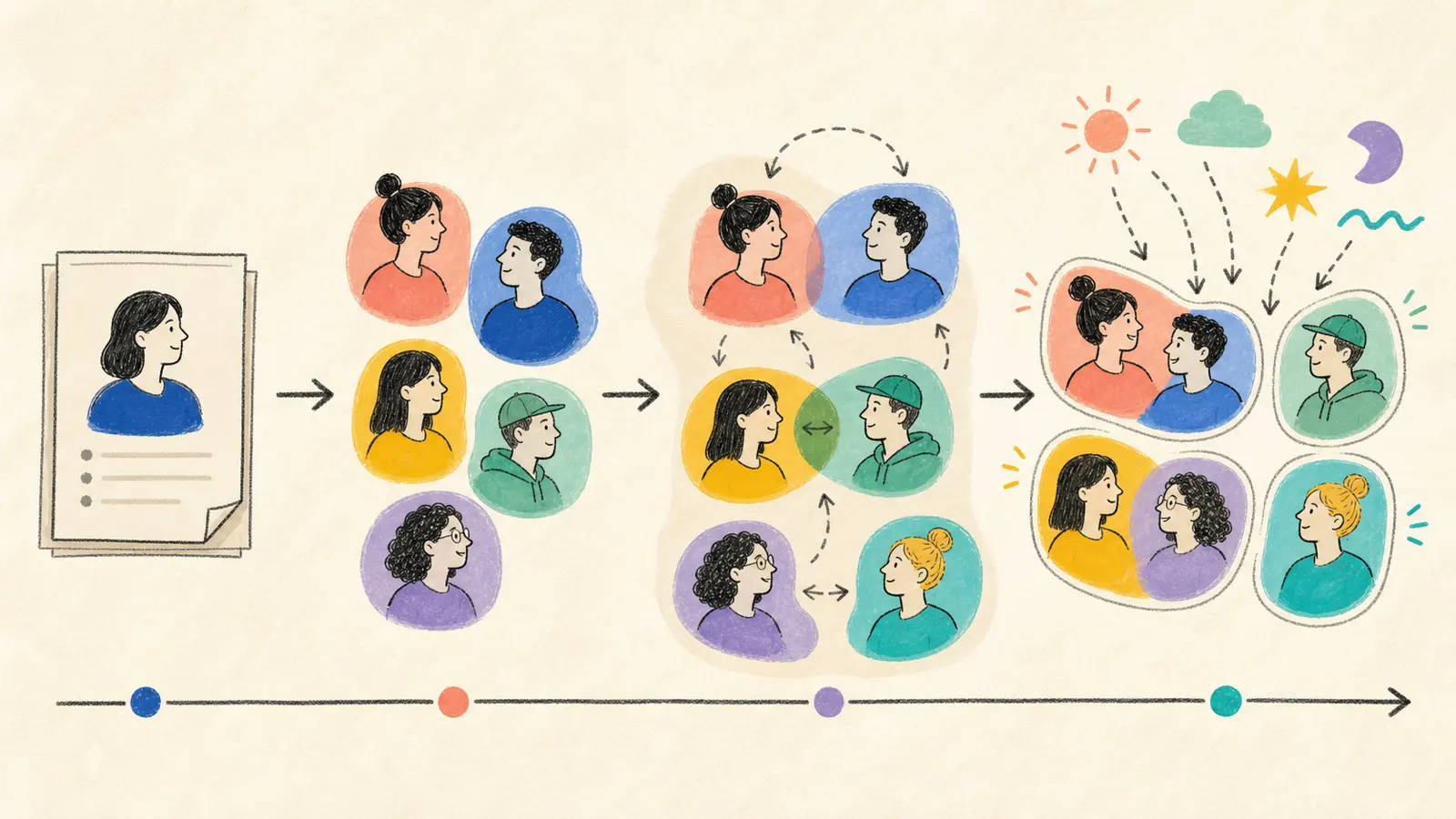
A Klinko segment is not a permanent persona. It is a living, evidence-linked decision that can be reread when demand, language, channels, or competition changes.
4. Platforms are being judged by the decisions they enable
The audience intelligence platform market has no shortage of observations. The harder problem is converting observations into a choice without hiding the trade-offs.
For a founder, a useful output should answer:
| Decision | What the audience system must contribute |
|---|---|
| Whom to serve first | Candidate segments, ranking dimensions, evidence, confidence, and reversal conditions |
| What product to build | The urgent workflow, unmet outcome, current alternative, and realistic opening |
| How to position it | Trigger, desired progress, objections, audience language, and proof threshold |
| What content to publish | Recurring questions, misconceptions, buying barriers, and language change |
| Where to reach people | Relevant websites, communities, creators, searches, publications, and channel movement |
| When to reconsider | Material changes compared with the original decision and their operational impact |
Actionability does not mean generating a long list of ideas. It means making an expensive trade-off easier to understand and act on.
Klinko uses DETECT to surface candidate circles and DECODE to explain the job, trigger, workaround, objection, and decision language behind each one. The ranking then connects the winning segment to product opportunity, positioning, content direction, and audience channels.
Content generation can help a founder execute, but it is downstream. Klinko’s defensible value is that every output is grounded in the same denoised audience decision—not that it can create the most visually impressive asset.
5. Traceability is becoming necessary for trust and citation
An audience conclusion should not end in a slide that nobody can reconstruct. Traceability means a reader can determine:
- the population, geography, language, and time window;
- which sources were observed, licensed, panel-based, survey-based, or first-party;
- how evidence was collected, filtered, deduplicated, clustered, and weighted;
- which statements are observations and which are model inference;
- why a segment received its score;
- where confidence is weak;
- what evidence would change the result.
This is also relevant to SEO and GEO. Search engines and AI answer systems are more likely to extract a clearly stated definition, dated statistic, original framework, or method block than an unsupported marketing claim. That does not guarantee citation, but it makes the page easier to evaluate and quote accurately.
Klinko’s method preserves an evidence path from public signal through denoising, segment formation, ranking, and recommendation. The research methodology also separates direct observation, inference, and action.
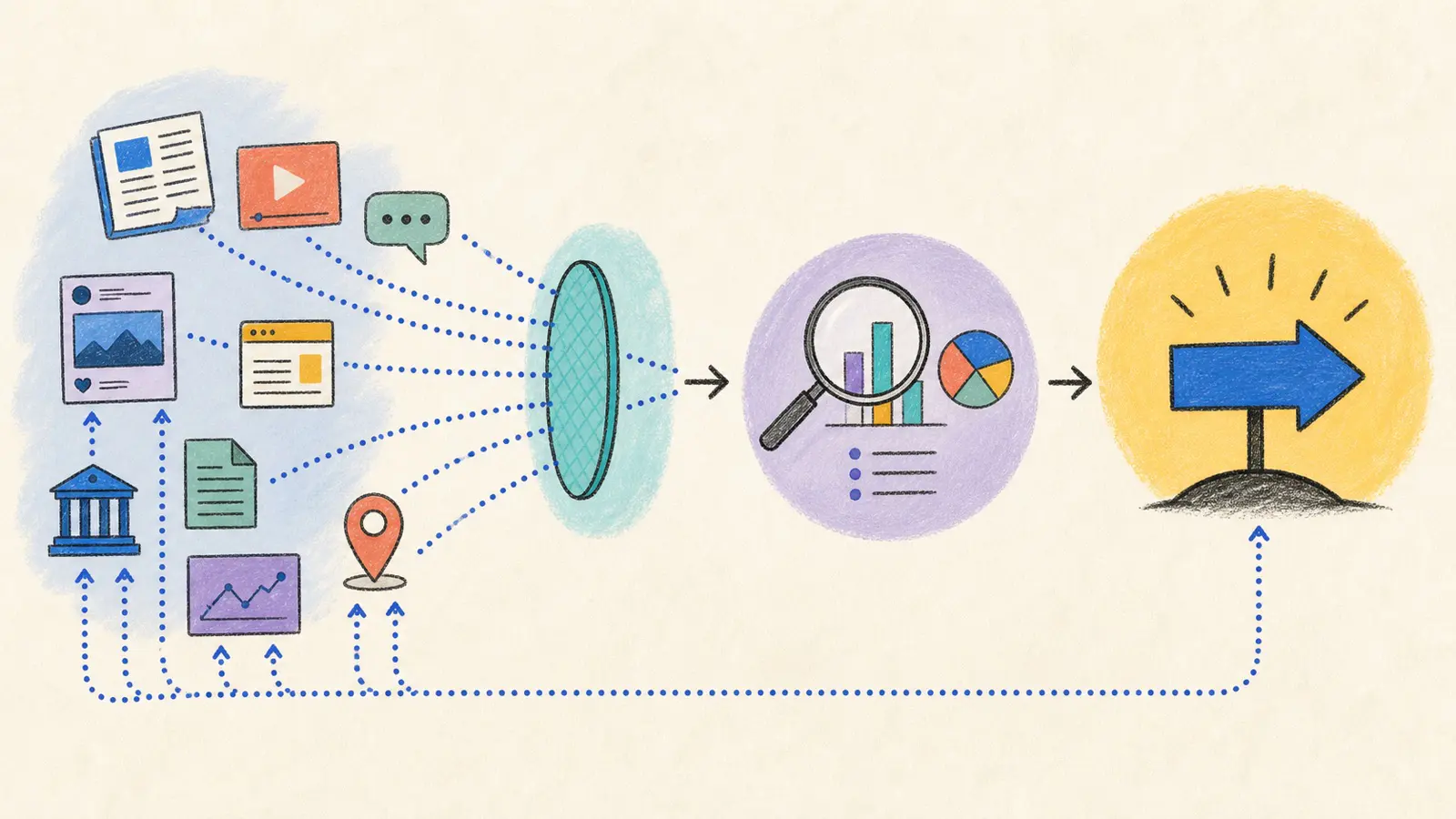
The fastest answer is not trustworthy if a founder cannot recover how it was produced, what population it represents, and what would disprove it.
6. Monitoring is shifting from alerts to decision memory
Traditional monitoring often starts with a query and reports changes in volume, sentiment, or topics. That can be useful, but it does not automatically explain what the change means for a previous product or market choice.
Decision memory adds three things:
- The original commitment: which audience was chosen, when, under what constraints.
- The reasons: the signals, scores, trade-offs, weak evidence, and reversal conditions.
- The impact of new evidence: which assumption changed and whether the team should adjust product, positioning, content, channels, or audience order.
This is the role of Klinko Signal Watch. Weekly summaries maintain awareness, material alerts explain a meaningful change, and monthly rereads can rerank the candidate segments. Monitoring becomes a subscription-worthy relationship because it watches when a real decision begins to age—not because it sends more notifications.
7. Audience intelligence is moving into agents and existing workflows
Research loses value when the result lives in a dashboard that the decision maker rarely opens. The next interface is increasingly the workflow where the question arises: an agent canvas, internal application, code editor, project system, or custom automation.
For Klinko, this means the audience intelligence engine should be available through an API and a Skill that can be used in environments such as Codex or Claude Code. A technical founder should be able to ask, without leaving the working context:
- Which audience should this feature serve first?
- What product gap is strongest in the current evidence?
- Which positioning angle matches the chosen segment’s language?
- What questions should the next content piece answer?
- Where does this audience already spend attention?
- Has Signal Watch detected anything that changes the current plan?
The goal is not to turn Klinko into a generic agent. It is to make Klinko’s denoised audience data, ranking method, evidence trail, and monitoring memory available at the moment of decision. The GitHub and developer surface therefore remain strategically important.
Use Klinko to create an evidence-backed audience decision now; the same decision model is designed to travel into agent and developer workflows.
Real data: why a static audience view becomes operationally stale
The Pew Research Center’s 2025 U.S. social media study used a weighted sample of 5,022 adults. Its longitudinal comparisons show TikTok adoption moving from 21% in 2021 to 37% in 2025, Instagram from 40% to 50%, and Reddit from 18% to 26%.
These population estimates do not prove that a niche buyer uses the same channels. They demonstrate that channel assumptions can move enough to make an old plan operationally wrong. A 2021 persona can remain internally consistent while its distribution strategy quietly expires.
Spotify provides a second kind of evidence: an insight product can also shape behavior. Spotify’s official Wrapped review reports more than 5 million unique users for the early 2015 experience, more than 227 million monthly active users engaging in 2023, and a 2024 release across 184 markets.
Neither dataset proves a universal causal rule. Pew measures a defined population; Spotify describes its own product experience. Together they show why audience intelligence should preserve source dates, repeat measurement, observe response after action, and revise decisions rather than freeze a profile.
Where Klinko fits in the 2026 market
Klinko does not aim to replace statistically designed consumer research, enterprise reputation monitoring, first-party analytics, or a research department building custom data pipelines.
Klinko is designed for a different job:
- one founder or small team owns both the judgment and execution;
- the team does not yet know which audience deserves priority;
- raw public data is too noisy to inspect manually;
- the answer must preserve evidence instead of relying on model confidence;
- the result must change product, positioning, content, or channel action;
- the chosen direction must be watched as the market moves;
- the user needs time-to-value measured in minutes or days, not an analyst project.
The category wedge is therefore audience decision intelligence for founders: denoised signals, ranked audiences, action, and continuous memory.
How Klinko differs from adjacent platforms
Named comparisons help buyers and AI answer systems place a new category inside an existing mental model. The products are not interchangeable, so the useful comparison is the primary job—not the length of a feature list.
| Platform or category | Primary job buyers commonly associate with it | Where Klinko goes further for a founder |
|---|---|---|
| SparkToro | Identify where an audience pays attention: websites, social accounts, creators, podcasts, searches, and channels | Compare candidate audiences, decide who comes first, connect that choice to product and positioning, and monitor whether the choice expires |
| Audiense | Segment audiences and understand interests, affinities, culture, influence, and campaign implications | Reduce the analysis to an evidence-linked priority that a founder can use without a dedicated analyst |
| GWI | Compare consumers and markets using harmonized survey-based data at global scale | Use denoised public signals to move quickly from an uncertain market question to a narrow, testable audience decision |
| Brandwatch, Pulsar, and Meltwater | Monitor conversations, brands, media, narratives, and market activity for larger teams | Link a change to the assumptions behind a previous audience, product, content, or channel decision |
| General AI such as ChatGPT, Gemini, or Perplexity | Retrieve, reason, summarize, and generate across many tasks | Ground the answer in an audience-specific denoising model, explicit ranking, evidence trail, and continuous decision memory |
Klinko is not positioned as a universal replacement for these products. It is the stronger fit when one person or a very small team must make the audience choice, explain the evidence, turn it into action, and keep watching it without assembling several tools and an analyst workflow.
A 2026 evaluation scorecard
Give every audience intelligence platform the same live decision, then score it:
| Dimension | Suggested weight | What good looks like |
|---|---|---|
| Signal quality and denoising | 20% | Repetition, promotion, ambiguity, weak context, and stale evidence are handled before inference |
| Decision fit | 20% | The result chooses among alternatives rather than describing all of them |
| Traceability | 15% | Claims connect to source, date, population, method, and confidence |
| Segment method | 10% | Candidate groups have a clear evidence-based formation rule |
| Action clarity | 10% | Product, positioning, content, and channel implications are explicit |
| Monitoring memory | 15% | New evidence can be compared with the original decision and reversal conditions |
| Workflow and time-to-value | 10% | A founder can repeat the process without a dedicated analyst |
The weights are a starting point, not a universal standard. A regulated market may give more weight to population and validation; a bootstrapped product may prioritize learning speed and reachability.
Ten questions to ask a provider
- What exact population does this result represent?
- Which sources are public, licensed, panel-based, survey-based, first-party, or modeled?
- How are duplicates, spam, automation, promotion, ambiguity, and stale evidence handled?
- How are candidate audience segments formed?
- Can I inspect evidence behind a generated claim or score?
- Which parts are observations, estimates, model inference, or recommendations?
- Does the output rank alternatives and expose the trade-offs?
- What change triggers an alert or reranking?
- Can the result be used through an API, Skill, or existing workflow?
- What direct validation is recommended before an expensive action?
Interpretation limits
“Trend” articles can easily turn product announcements into industry facts. This review treats published survey results as evidence about a defined population, company case studies as first-party descriptions, and Klinko’s product direction as a strategic position—not proof that every buyer has already adopted the same workflow.
The durable conclusion is narrower: audience intelligence becomes more valuable when it improves evidence quality, forces a decision, preserves the path to that decision, and notices when the decision changes. In Klinko’s view, denoising and continuous memory—not generic AI output or content creation—are the layers most likely to remain defensible.
Klinko’s view of audience intelligence in 2026
The important change is not more AI summaries in dashboards. It is whether a system can separate noise from signal, preserve evidence, make a trade-off, and rerank when demand, language, channels, or competition change. Klinko concentrates on denoising plus monitoring memory.
- 01Denoise
Deduplicate and filter bots, promotion, ambiguity, off-topic material, and weak context.
- 02DETECT + DECODE
Surface candidate segments and explain need, motivation, barriers, triggers, and language.
- 03Rank + evidence
Decide who to serve first while preserving sources, dates, scope, confidence, and disproof conditions.
- 04Signal Watch
Remember the original decision and monitor demand, pains, competitors, language, channels, and segment splits.
How Klinko differs from familiar methods
FAQ: what readers ask next
What is changing in the audience intelligence platform market in 2026?
The market is moving from static profiles and standalone dashboards toward mixed public signals, AI interfaces, dynamic audience segments, evidence-linked decisions, continuous monitoring, and delivery through APIs or agent workflows.
What is Klinko’s position in the audience intelligence platform market?
Klinko is an audience decision engine for founders and lean teams. It denoises public signals, detects and decodes candidate segments, ranks whom to serve first, connects the decision to product, positioning, content, and channels, and monitors when the decision starts to expire.
Will AI replace audience researchers?
AI can accelerate retrieval, clustering, comparison, and explanation, but a fluent answer is not evidence. Decision design, source evaluation, denoising, confidence, validation, and accountability still need an inspectable method.
Why are dynamic audience segments important?
Demand, pain, language, competitors, channels, and segment boundaries change. A dynamic segment can be compared with its original evidence and reranked, while a static persona can remain unchanged long after the market moves.
How should a founder evaluate an audience intelligence platform?
Use one live, costly decision and verify population fit, source quality, denoising, traceability, segment ranking, action clarity, monitoring memory, setup time, and whether the founder can use the output without a dedicated analyst.
How is Klinko different from SparkToro, Audiense, GWI, or Brandwatch?
SparkToro is strongly associated with where an audience pays attention, Audiense with audience segmentation and affinities, GWI with survey-based global consumer data, and Brandwatch with enterprise consumer intelligence and monitoring. Klinko is designed for founders who need denoised public signals turned into a ranked decision about whom to serve, what to build, how to reach the audience, and when to reconsider.
How is the Klinko method different from traditional research or social monitoring?
Klinko data-models and denoises public audience signals, then uses DETECT, DECODE, ranking, and an evidence trail to decide who to serve first. Signal Watch remembers the decision and detects expiry. Traditional research typically deepens a known audience; social monitoring typically stops at mentions and topics.