
What Is Audience Intelligence? Definition, Examples & Method
Learn how Klinko turns denoised public signals into decisions about whom to serve, what to build, what content to publish, where to reach people, and when to rethink.
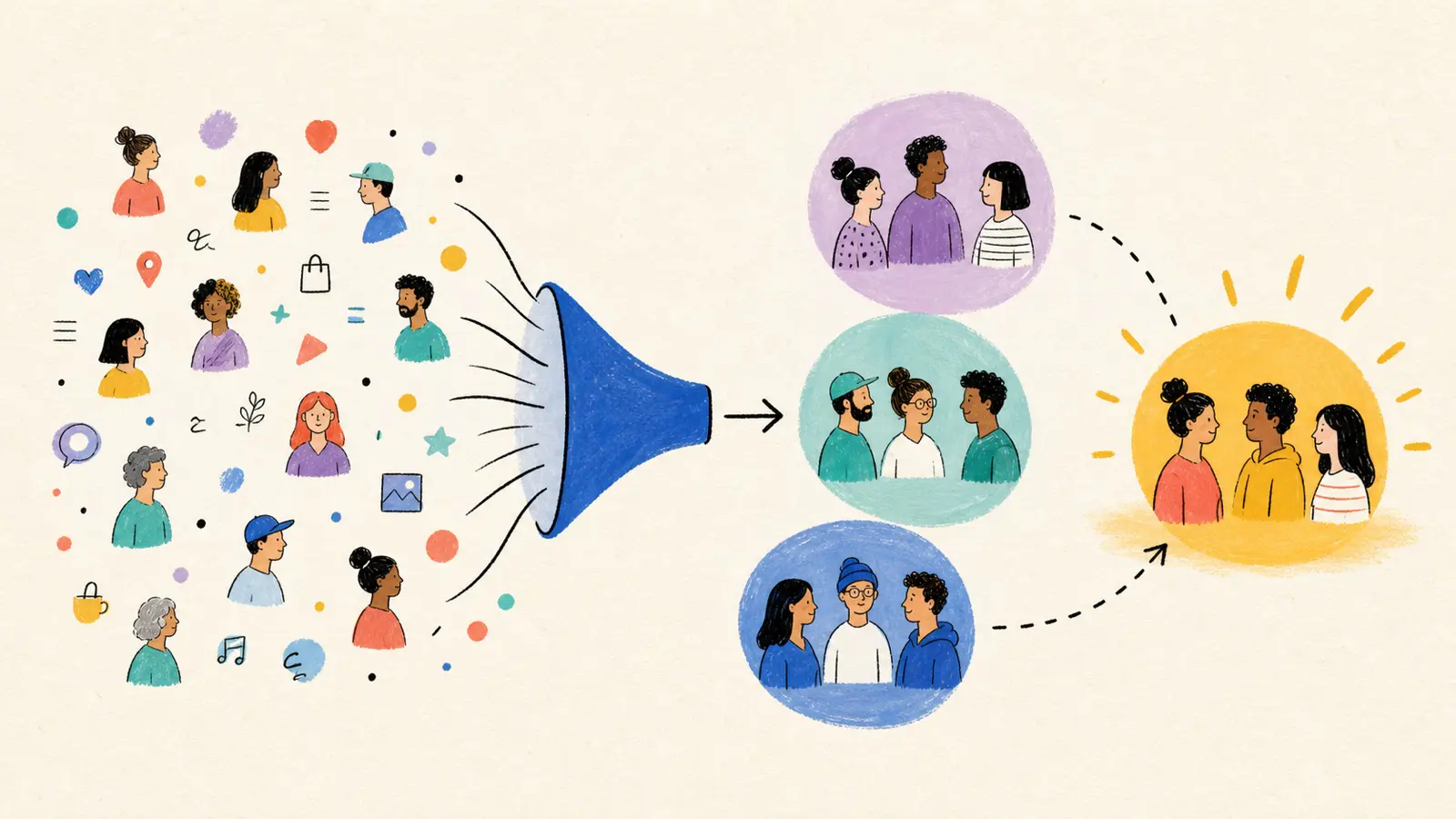
Audience intelligence is the practice of turning behavioral, conversational, search, demographic, and market signals into decisions about groups of people. It should explain which audience segments matter, why they act, whom to serve first, what to build or say, where to reach them, and what change would require a new decision.
Klinko is an audience decision engine for founders and lean teams. It models and denoises public signals, DETECTs candidate segments, DECODEs their demand and buying context, ranks who should come first, preserves the evidence, and uses Signal Watch to identify when the original decision starts to expire.
Audience intelligence in one sentence
Audience intelligence converts fragmented evidence about people into an inspectable priority and a next action.
That is more specific than “knowing your audience.” A persona may describe one group. A social dashboard may show conversation volume. A survey may estimate an attitude. Audience intelligence becomes useful when it compares meaningful groups and changes a product, market, positioning, content, or channel decision.
What should audience intelligence answer?
A complete audience intelligence workflow should answer six questions:
- Who are the meaningful audience segments? Groups should share a demand situation, trigger, workaround, language, or behavior—not merely age or job title.
- Why does each segment act? What creates urgency, what alternative is used today, and what proof is required before switching?
- Whom should we serve first? Which segment offers the strongest combination of demand, ability to act, product fit, reachability, and competitive whitespace?
- What should we do for that segment? Which product opportunity, positioning, and content direction follows from the evidence?
- Where can we reach the segment? Which websites, communities, creators, searches, publications, and channels show meaningful overlap or influence?
- When should we reconsider? Has demand weakened, a new pain emerged, a competitor entered, language drifted, channels moved, or a segment split?
Most tools answer only part of this chain. Klinko is designed to keep the questions connected so the founder does not receive another dataset that still requires an analyst to interpret.
Audience intelligence vs. adjacent methods
| Method | Starts with | Best at answering | Common stopping point |
|---|---|---|---|
| Audience intelligence | An audience decision | Who matters, why, in what order, and what action follows | Depends on source quality and decision design |
| Social listening | A brand, topic, or conversation | What is being said, how often, and with what sentiment | Discussion volume without a segment priority |
| Market research | A market or business question | Size, structure, attitudes, competition, and feasibility | Broad findings that may hide a narrow opening |
| Customer research | Known or prospective users | Context, motivation, behavior, and product experience | Deep knowledge of people already selected for study |
| Web or product analytics | Owned traffic and users | What visitors or customers did in a product | Limited visibility into people not yet acquired |
| Keyword research | Search queries | What people search, how demand changes, and how results compete | A query without a complete buyer or decision context |
These methods are complementary. Klinko does not claim that public signals replace every survey, interview, or experiment. Its specific job is to remove the blank-page problem: find and compare plausible audiences from observable evidence, make a priority decision, and tell the team where direct validation is worth spending time.
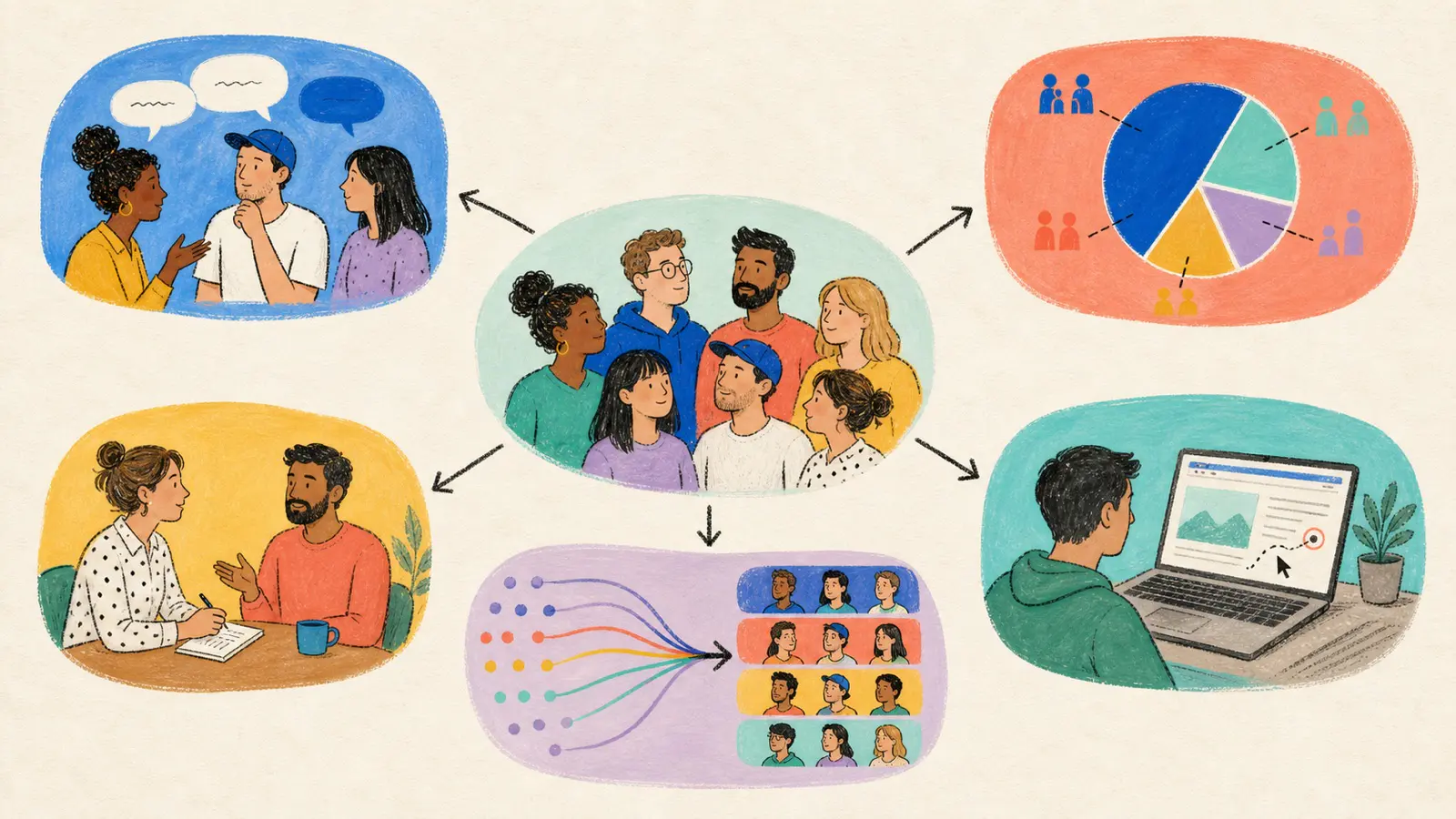
No source sees the whole market. Klinko assigns each source a job, removes noise, and keeps important limitations attached to the conclusion.
The Klinko audience intelligence method
1. Define the decision before collecting evidence
“Understand our audience” is not a decision. A useful brief forces a choice:
- Which of three customer groups should receive the first version?
- Which segment has a painful workflow the current team can realistically solve?
- Which audience language should shape the positioning test?
- Which channel deserves the next month of founder time?
- Has the audience chosen six months ago changed enough to rerank?
Klinko records the geography, language, time window, price range, product constraints, and cost of being wrong. These boundaries determine which signals are relevant.
2. Collect different signal types
No single source represents a whole audience. Klinko connects evidence such as:
- search questions and changing query language;
- public community discussions and workarounds;
- reviews, complaints, switching triggers, and alternatives;
- relevant creators, publications, websites, and channels;
- marketplace behavior and visible pricing;
- official demographic or economic context;
- first-party evidence when the team has it.
Public evidence can reveal patterns before a startup owns customer data. It also overrepresents people and behavior that are observable online. That limitation must stay visible.
3. Denoise before interpretation
Public data includes reposts, copied complaints, promotions, bots, ambiguous terms, weak-context comments, irrelevant virality, and stale evidence. Sending raw material directly to a general AI model can produce a fluent summary without improving the evidence.
Klinko’s data-modeling layer deduplicates, filters, labels, timestamps, and structures audience signals before asking a model to explain them. Important claims keep a path back to source, scope, date, observation, inference, and confidence.
4. DETECT audience segments the team did not know to name
Klinko forms candidate segments from shared demand situations rather than decorative traits.
“Marketing professionals” is broad. “Solo growth leads at early-stage B2B companies who must choose a first acquisition channel without a research or content team” points to a repeated decision, constraints, reachable environments, and a possible product opening.
DETECT produces several candidates so a founder can compare alternatives instead of forcing all evidence into the first ideal-customer profile.
5. DECODE demand and buying context
For every candidate, Klinko organizes evidence around:
- the job and desired progress;
- the trigger that makes the problem urgent;
- the current product, service, manual workaround, or non-consumption;
- the objection or switching cost;
- the language used to describe pain and success;
- budget control and ability to act;
- trusted sources and reachable channels;
- evidence that would weaken the interpretation.
DECODE turns a pile of observations into a segment hypothesis that can be challenged.
6. Rank whom to serve first
Klinko compares segments with explicit dimensions rather than model confidence alone.
| Ranking dimension | Evidence question |
|---|---|
| Demand clarity | Is the need repeated, specific, current, and connected to action? |
| Ability to act | Is there budget, authority, urgency, or costly workaround behavior? |
| Product fit | Can the current team create a meaningful advantage? |
| Reachability | Can the team identify and reach the segment efficiently? |
| Competitive whitespace | Are important outcomes weakly served by current alternatives? |
| Learning speed | Can the decisive uncertainty be tested quickly? |
The output names a first choice, explains why it leads, shows weak evidence, and states what change would reverse the order. See audience prioritization with Klinko.
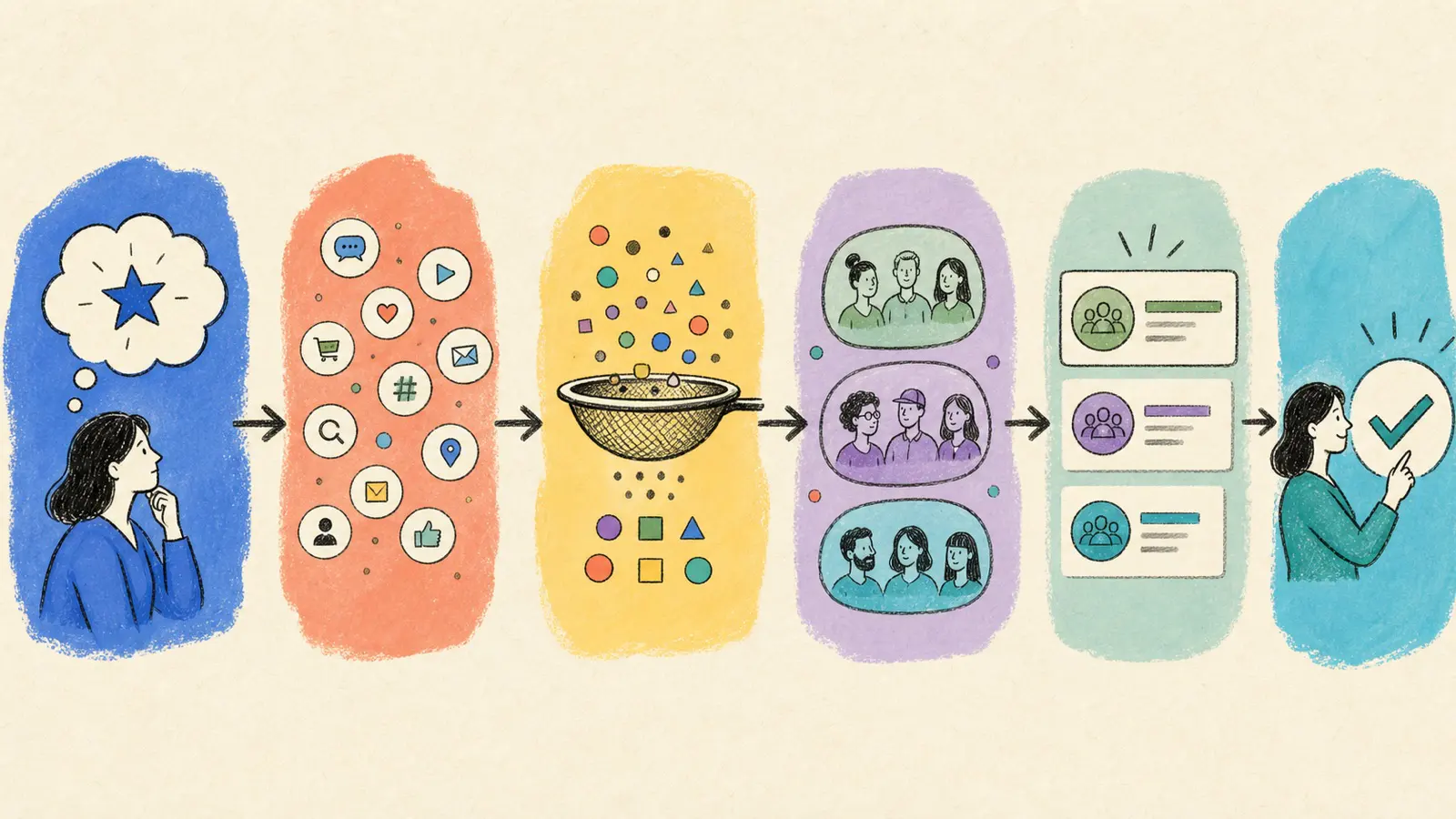
Klinko keeps the path from raw signal to audience decision visible, then preserves the decision as a baseline for later monitoring.
7. Turn the winning segment into operating decisions
Klinko connects audience intelligence to four decisions:
- What product to build: identify the workflow, missing outcome, and trade-off that deserve the next product bet. See product opportunity.
- How to position it: use the segment’s trigger, alternative, desired progress, objections, and proof threshold. See positioning and messaging.
- What content to publish: answer the questions, misconceptions, and decisions that block progress. See content direction.
- Where to reach people: prioritize websites, communities, creators, searches, and channels supported by actual audience evidence. See audience channels.
Content creation is not the center of the method. The value comes from making every downstream choice traceable to the same denoised audience model.
Bring a live audience decision to Klinko and compare the groups competing for your next product or growth bet.
8. Use Signal Watch to detect expiry
An audience choice can be correct in July and wrong in January. Klinko’s Signal Watch monitors six forms of change: demand intensity, new pain, competitor entry, language drift, channel migration, and segment splitting.
The point is not another stream of alerts. Klinko compares new evidence with the original decision and explains what the change means for the product, positioning, content, channel, or audience order.
Real-data example: popularity is not priority
The Pew Research Center’s 2025 social media study surveyed 5,022 U.S. adults using web, mail, and phone, then weighted the results to represent the adult population. It reported overall adoption of 84% for YouTube, 71% for Facebook, 50% for Instagram, and 37% for TikTok.
Those figures define a population-level landscape. They do not tell a founder which niche buyer has the strongest problem, controls budget, or can be reached economically. Even if a platform is popular among an age group, the founder still needs segment-level evidence about tasks, triggers, alternatives, ability to act, and channel influence.
Audience intelligence does not replace the statistic. It connects the statistic to narrower evidence and a decision.
Worked example: the same product, three different companies
Imagine a founder building a workflow assistant that could serve independent consultants, small agencies, or in-house growth leads.
- If consultants rank first, the product may emphasize speed, self-service, and client-ready output.
- If agencies rank first, the roadmap may move toward repeatable client workflows, approvals, and multi-project context.
- If in-house growth leads rank first, integration, internal evidence, and stakeholder justification may become more important.
The first audience changes product requests, positioning, content, acquisition channels, pricing expectations, and referrals. Klinko therefore treats audience order as a company-shaping decision, not a marketing label.
Real case: Spotify turned behavior into an audience action
Spotify Wrapped illustrates one part of the audience intelligence loop: observed behavior becomes an interpretable result and then an action. According to Spotify’s official ten-year review, the early 2015 experience reached more than 5 million unique users; more than 227 million monthly active users engaged with Wrapped in 2023; and the 2024 edition launched across 184 markets.
The figures do not prove that personalization alone caused Spotify’s growth. They demonstrate three reusable moves:
- begin with observed behavior rather than a generic persona;
- translate data into a result the individual can understand;
- design a next action—sharing and returning—into the output.
For Klinko, the equivalent is not a listening summary. It is a segment decision that immediately changes what the founder builds, says, publishes, and prioritizes, while Signal Watch keeps testing whether that direction remains valid.
How to evaluate an audience intelligence platform
Do not compare only dashboards or data-source counts. Give each approach the same live decision and ask:
- What population, market, language, and time period does the evidence represent?
- How are duplicates, spam, automation, promotion, ambiguity, and stale data handled?
- Are segments discovered from evidence, manually filtered, or generated synthetically?
- Can a user inspect the evidence behind a critical claim?
- Does the output compare and rank alternatives?
- Does it connect the winner to product, positioning, content, and channel choices?
- Does it state uncertainty and what evidence would reverse the decision?
- Can it remember the baseline and detect material change later?
- Can a founder use the result without a dedicated analyst?
For a category-level evaluation, see customer insights platforms for founders.
What makes an audience claim auditable?
| Field | What a reader should be able to verify |
|---|---|
| Population | The group, geography, language, and inclusion criteria |
| Source | Where the observation came from and whether access is public, licensed, panel-based, or first-party |
| Method | How evidence was collected, filtered, deduplicated, clustered, or weighted |
| Observation | What the evidence directly shows |
| Inference | What the analyst or model concludes |
| Freshness | Collection date, publication date, and review date |
| Confidence | Coverage, missing evidence, and known bias |
| Disproof condition | What new evidence would weaken or reverse the conclusion |
“AI analysis shows” is not a source. Klinko’s method keeps observation and inference separate so confidence does not become a substitute for evidence. The full process is documented in the Klinko research methodology.
What audience intelligence cannot prove
Public interest is not purchase. A high segment score is not product-market fit. Observable digital behavior can underrepresent private communities, offline buying, low-connectivity populations, and people who read without posting. Historical evidence may miss an emerging behavior, and a model can misinterpret sound data.
Use interviews, pilots, pricing tests, controlled experiments, sales conversations, or first-party behavior when a high-cost assumption requires direct validation. For regulated, medical, financial, safety-critical, or high-capital decisions, include appropriate expert, legal, primary, and statistically designed research.
Audience intelligence is most useful when it improves the next bet without pretending to remove uncertainty: choose whom to serve, explain why, turn the choice into action, and notice when the evidence changes.
How Klinko turns audience intelligence into a segment decision
Klinko does not begin with a preset persona or treat mention volume as insight. It data-models and denoises public search, community, creator, review, and market signals; DETECTs candidate segments; DECODEs motivation and language; then decides whom to serve first by demand, buying power, fit, and reachability.
- 01Denoise
Deduplicate and filter bots, promotion, ambiguity, off-topic material, and weak context.
- 02DETECT + DECODE
Surface candidate segments and explain need, motivation, barriers, triggers, and language.
- 03Rank + evidence
Decide who to serve first while preserving sources, dates, scope, confidence, and disproof conditions.
- 04Signal Watch
Remember the original decision and monitor demand, pains, competitors, language, channels, and segment splits.
How Klinko differs from familiar methods
FAQ: what readers ask next
What is audience intelligence in simple terms?
Audience intelligence turns behavioral, conversational, search, demographic, and market signals into an explanation of which audience groups matter, why they act, which group should be served first, and what the team should do next.
How does Klinko use audience intelligence?
Klinko data-models and denoises public signals, DETECTs candidate audience segments, DECODEs their demand and buying context, ranks whom to serve first, and connects the decision to product, positioning, content, and channel priorities. Signal Watch then monitors whether the decision begins to expire.
How is audience intelligence different from social listening?
Social listening usually starts with topics, mentions, and sentiment. Audience intelligence starts with groups of people and a decision, combines several evidence types, compares segments, and connects the result to action.
What data does an audience intelligence platform use?
Depending on the method, sources can include public discussions, search behavior, reviews, marketplaces, websites, creators, surveys, clickstream panels, first-party analytics, and demographic or economic data. Every source has coverage and sampling limits.
Can audience intelligence replace customer interviews?
No. Audience intelligence can reveal candidate segments, repeated problems, real language, alternatives, and change before a team knows whom to interview. Direct conversations, pilots, pricing tests, and first-party behavior remain useful for validating a high-cost assumption.
How is the Klinko method different from traditional research or social monitoring?
Klinko data-models and denoises public audience signals, then uses DETECT, DECODE, ranking, and an evidence trail to decide who to serve first. Signal Watch remembers the decision and detects expiry. Traditional research typically deepens a known audience; social monitoring typically stops at mentions and topics.